
Lunzjata Valley (Wied il-Lunzjata), Gozo

Lunzjata Valley is a short, focused outing rather than a half-day sight: allow roughly an hour on foot for the chapel, the fountain and the elevated track along the valley wall. It rewards anyone who wants to see working Gozitan farmland and a watercourse fed by permanent springs, minutes from Victoria. This guide covers where the valley sits, how to approach it, what to look at and how to pair it with nearby Xlendi or Victoria.
Two things make the visit worth the detour. The valley holds a small chapel partly dug out of the rock and a stone fountain that still pours spring water, and both sit within a few minutes' walk of each other on a narrow lane below the Victoria to Xlendi road.
Where Lunzjata Valley is
Lunzjata Valley, Il-Wied tal-Lunzjata in Maltese, lies in the limits of Kercem, just off the road running from Victoria to Xlendi. It is the upper part of Wied ix-Xlendi, the watercourse that continues down towards Xlendi Bay, so the water you see at Lunzjata is the same system that feeds the valley below.
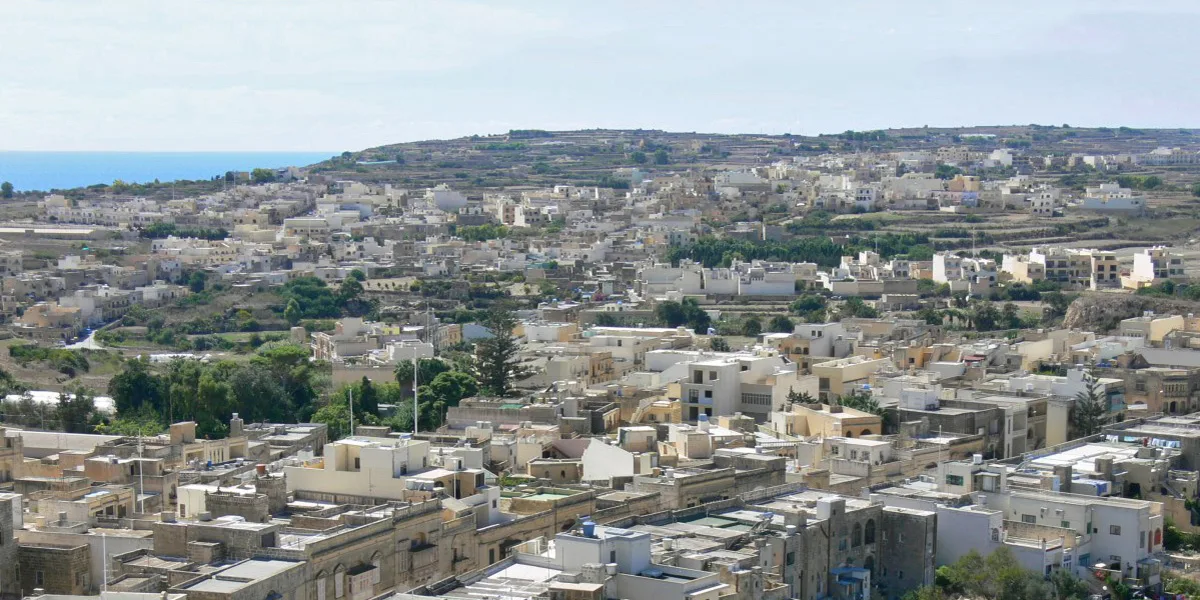
Seen from the villages, the valley sits between Fontana and Kercem, with terraced fields dropping steeply from the ridge and traditional houses lining the top edge. The approach from Victoria is short: the valley lies about 1.6 km from the Victoria sports complex, which translates to a few minutes by car.
Because the valley forms part of a protected Natura 2000 site alongside Wied Kantra and Wied tax-Xlendi, treat the cultivated plots as private farmland and stay on the tracks and paths rather than crossing field walls.

How to get there from Victoria
By car, head out of Victoria on the Xlendi road and turn off for the valley; the lane down to the chapel is steep and narrow, so drive past it and park where the road allows rather than committing to the descent. Public transport reaches the area too, with the valley accessible from Victoria in roughly six minutes by bus, though you will still walk the last stretch on foot.
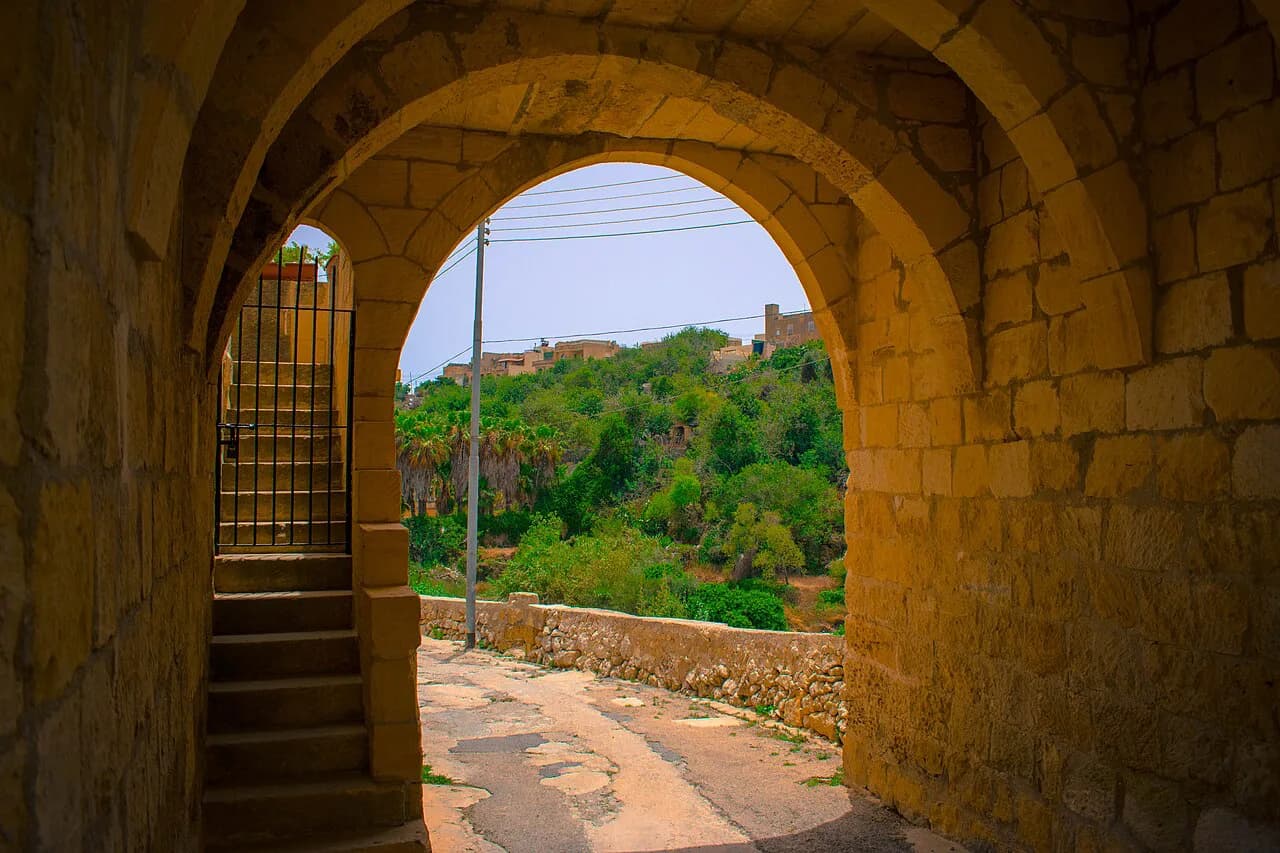
On foot the approach is the point: walkers coming from Victoria describe a sharp left turn down a steep, narrow road, then a sign and the entrance, with a stone archway framing the chapel as you arrive. Wear shoes with grip, since the surface is uneven and the gradient is real in both directions.
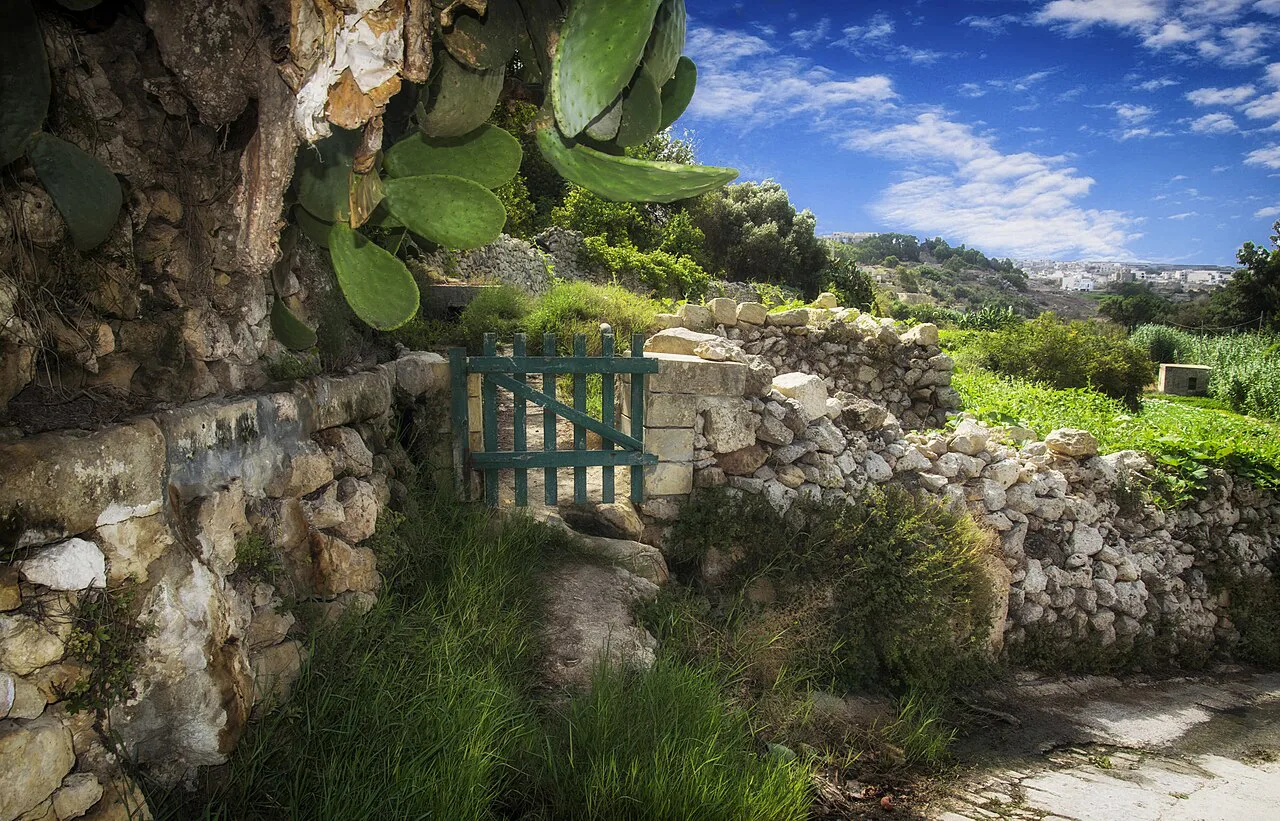
There is no visitor centre, ticket office or formal entrance along the lane, and the chapel and fountain sit on a working farmland track. Treat it as a place of worship and a cultivated valley rather than a managed attraction, stay on the tracks and keep gates and voices as you found them.

The Chapel of the Annunciation
The chapel is the first thing you see, set into the rock of the valley wall, and it is small enough to hold around 20 people at full capacity, which gives it an intimate feel. Inside, red damask drapes cover the walls and an Annunciation painting hangs within.
Versions of its date differ: one account gives the early 16th century, while another places the current chapel in 1629, after worship in a natural cave above the valley up to 1347. Either way, the building you see is a modest rural chapel of the kind built to serve farmers working the fields and travellers passing through.
The chapel is said to welcome a mainly older local congregation for religious services, so on occasions you may find people gathered on the parvis in front. If you arrive and anyone is praying or a service is under way, wait quietly or come back later, and keep voices low inside.
The 17th-century fountain
Below and beside the chapel stands the valley's other landmark, a stone fountain commissioned by Grand Master Ramon Perellos y Roccaful and built in 1698 by Ercole Martino Testaferrata. Its mouth pours out water drawn from the spring running through the rocks of Lunzjata, and the flow is generous rather than a trickle.
Din l-Art Helwa, the heritage organisation that protects the fountain, restored it in 2007, so what you see is a maintained structure rather than a ruin. Local people still use the same spring water, and the source can be traced through the valley system to Għajn Tuta in Kercem.
The channels and springs are working water for the cultivated plots below rather than a bathing or play feature, so keep out of them and do not climb on the fountain structure.
Walking the track along the valley wall
The best viewpoint is the elevated track that runs along the valley side, giving you a sweep over terraced fields held by dry stone walls, dense vegetation and the small farms below. Walk it slowly, because most of the detail, the seep of springs out of the bank and the run-off cisterns, is at close range.
Down on the valley floor, small canals lined with reeds carry the water between vegetable plots where olive, almond, pomegranate and carob trees grow. Reeds, sedge and water-plantain line the watercourse, and shade comes mainly from these trees rather than from the slopes.
Wildlife is a quiet bonus rather than a guaranteed sight: the valley is known for the Maltese freshwater crab and holds breeding Maltese painted frogs, and it attracts spring and autumn migrants such as herons, egrets and flycatchers. Keep to the bank, bin nothing, and you will see more.
What grows here and why the water matters
Lunzjata keeps a permanent freshwater supply, which is unusual enough on the Maltese islands to make it one of Gozo's most important fertile farming areas. Farmers grow lettuce and other green leaves alongside onions, potatoes and capsicums, with cereal crops on higher ground to feed livestock.
The Knights of the Order of St John once used the valley as a hunting area before it was developed for agriculture, and the enclosed, watered character that made it good hunting is what makes it good for growing today.
Time to allow and when to walk
Set aside about an hour to cover the chapel, the fountain and a loop along the wall track at an unhurried pace, or half that if you only go down to the chapel. Add time if you plan to photograph the terraces or sit by the water.
The valley sides are largely cultivated and exposed, and the stone-tracks can get hot and bright in the middle of a summer day, so walk in the morning or late afternoon and carry water. The track surface is uneven and narrow in places, which is the main trade-off against the quiet.
Nearby: Xlendi, Victoria and Fontana
Because the valley sits on the road from Victoria to Xlendi, it slots neatly into a run down to Xlendi Bay, where the watercourse you have followed finally reaches the sea. In the other direction, Victoria's centre gives you the rest of an afternoon.
If you enjoy quiet valleys and figure them into your plans with other sights, they sit comfortably alongside the wider list of Gozo Attractions: 9 Visitor Guides. For a very different, drier valley landscape, Wied il-Għasri is the obvious comparison.
Fontana sits on the Kercem side of the valley and makes a sensible point to rejoin the main road rather than retracing the narrow lane.
Is Lunzjata Valley worth the detour?
Yes, if you want an hour of real farmland, a small rock-cut chapel and a working spring fountain with no tickets and no crowds, and you are already heading to or from Xlendi or Victoria. Skip it if you are short of time and chasing the island's headline sights.
To build the rest of the day, pair it with Wied il-Għasri, Ta' Pinu basilica or the Gozo Attractions hub, and plan the valley as the quiet middle of an afternoon rather than a destination in its own right.