
St Paul's Church and Grotto, Rabat: A Visitor's Guide

St Paul's Church in Rabat, Malta, is a Catholic collegiate church, and visitors come for two things joined at the same address: the church itself and St Paul's Grotto beneath it. The Grotto is reached through the Wignacourt Museum entrance on Triq il-Kulleġġ, the side street beside the church, rather than through the main church doors. This guide covers the entrance, what the ticket includes, what you actually see underground and how long to give it.
Expect more than a single church interior. The ticket covers the Grotto, the church and Sanctuary of St Publius, Punic and Roman catacombs, World War II air-raid shelters and the Wignacourt Museum, which is why the complex swallows a few hours rather than twenty minutes.
What St Paul's Church and the Grotto are
The Collegiate Church of St Paul stands in the centre of Rabat and is an active place of worship as well as a monument, with masses held inside. The Grotto below is a cave where, according to the tradition the site is built on, St Paul preached after being shipwrecked on Malta while travelling towards Rome. Two popes have visited: John Paul II in 1990 and Benedict in 2010.
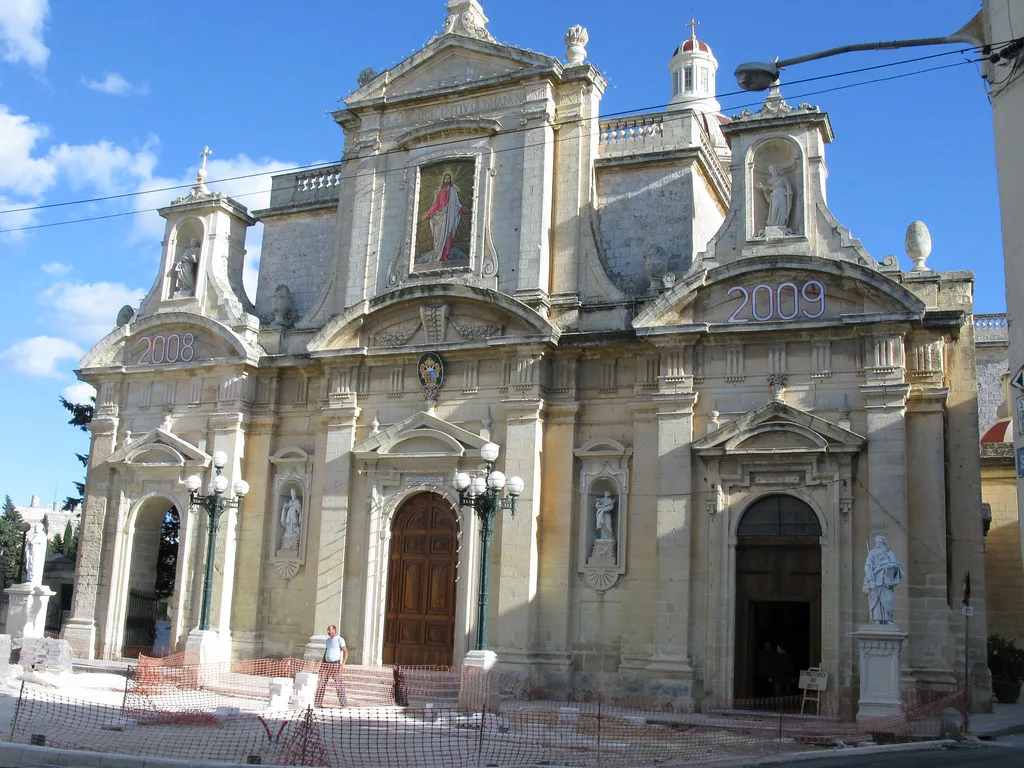
The altar space of the Grotto has been enlarged over the centuries to hold pilgrims, and it now contains a statue of St Paul, a gift from Grand Master Pinto, alongside several altars. The church above and the Sanctuary of St Publius share a common facade, which is why many arrivals assume they are looking at one building.
Where the entrance is on Triq il-Kulleġġ
Face the church in its small square and look to the right-hand side for College Street, Triq il-Kulleġġ in Maltese. A short way down on the right is the Wignacourt Museum door, which is the way in to the Grotto, the catacombs and the museum; the church is also accessible from this complex.
This is the detail that catches people out. Turning up at the church steps during a service will not get you into the Grotto, and turning up at the museum door expecting only a museum undersells what is below. Rabat's centre is compact and walkable, so once you are in the square the entrance takes a minute to find.

How to get to Rabat from Valletta, Mdina and Buġibba
Rabat is a main residential town with extensive bus routes linking it to Valletta and other towns across Malta, which makes the bus the budget option from Valletta, Buġibba, Qawra or Sliema. Bus tickets can be bought on board. Route numbers and timetables change, so confirm the current route before you set out.
By car, Rabat has plentiful free parking and a petrol station, and the drive from the Buġibba and Qawra area takes roughly 25 minutes. From Mdina, the walk down through the old capital's gate into Rabat is short and puts you close to the church square without any parking at all.
If you are building a morning out of the area, the wider set of Rabat Attractions: 11 Visitor Guides gives you the other churches, palaces and gardens within walking or short-drive range of the church, so you can group them around this visit.
Opening hours and tickets for the Wignacourt Museum complex
The complex keeps full-week opening hours, running daily from 09:30 to 17:00. That single window covers the Grotto, the catacombs, the shelters and the museum, so a late-afternoon arrival leaves you short of time for all of it.
Entry is ticketed, not free. Adults pay 5 euros, students from 12 and seniors from 61 pay 3.50 euros, and an audio guide in English, French, Spanish, Italian, German, Russian or Maltese costs 2 euros more; bring ID or a student card for the reduced rate.
These are the most recent published figures, so treat them as a guide and confirm the current price at the desk or the museum's own site before you budget. Children under 12 had no displayed price at the time of that record, so ask when you buy.
What the ticket covers
One ticket runs across five areas: St Paul's Grotto, St Paul's Church and the Sanctuary of St Publius, the World War II air-raid shelters, the Punic and Roman catacombs, and the Wignacourt Museum. Because the ticket is not split, the sensible approach is to see everything in one pass rather than pick a favourite and leave.
If burial shafts and rock-cut tombs are the part that interests you most, give the catacombs their own attention on the St Paul's Catacombs, Rabat page before you go, and treat the church complex as the fuller, ticket-inclusive version of the same visit.
Inside the Grotto: the descent, the altars and the statue
From the museum you pass a turnstile into a small introductory room, then climb down a flight of stone steps into the cave. St Paul's Catacombs and the WWII shelters branch off to the left; the Grotto itself is straight ahead, through a few more steps into a medium-sized room of altars, statues and frescoes.
The most venerated spot is a small room immediately to the left at the base of the stairs, holding a statue of St Paul flanked by ornate lamps with a plaque of photographs from John Paul II's visit. Only one wall fresco survives in the main room, and the altars include those of St Luke and St Paul.
The Grotto is genuinely small, so it fills quickly in high summer; an early-morning slot gives you room to stand and look rather than shuffle through. If the cave itself is the point of your trip, the St Paul's Grotto in Rabat page covers the shrine in more depth.
The Collegiate Church of St Paul and the Sanctuary of St Publius
Above the Grotto sits the Sanctuary of St Publius, added to the Church of St Paul in 1617 under the Order of St John, and it shares the church's facade. Look for the eight-pointed crosses of the Order inside; they are easy to miss among the ornament.
The church is a working place of worship, so parts of it may be closed to sightseers during mass, and quiet and covered shoulders are the norm in Maltese churches. Treat the church as the part of the visit that may be short and the museum complex as the part you can plan around.
The catacombs and the WWII shelters below
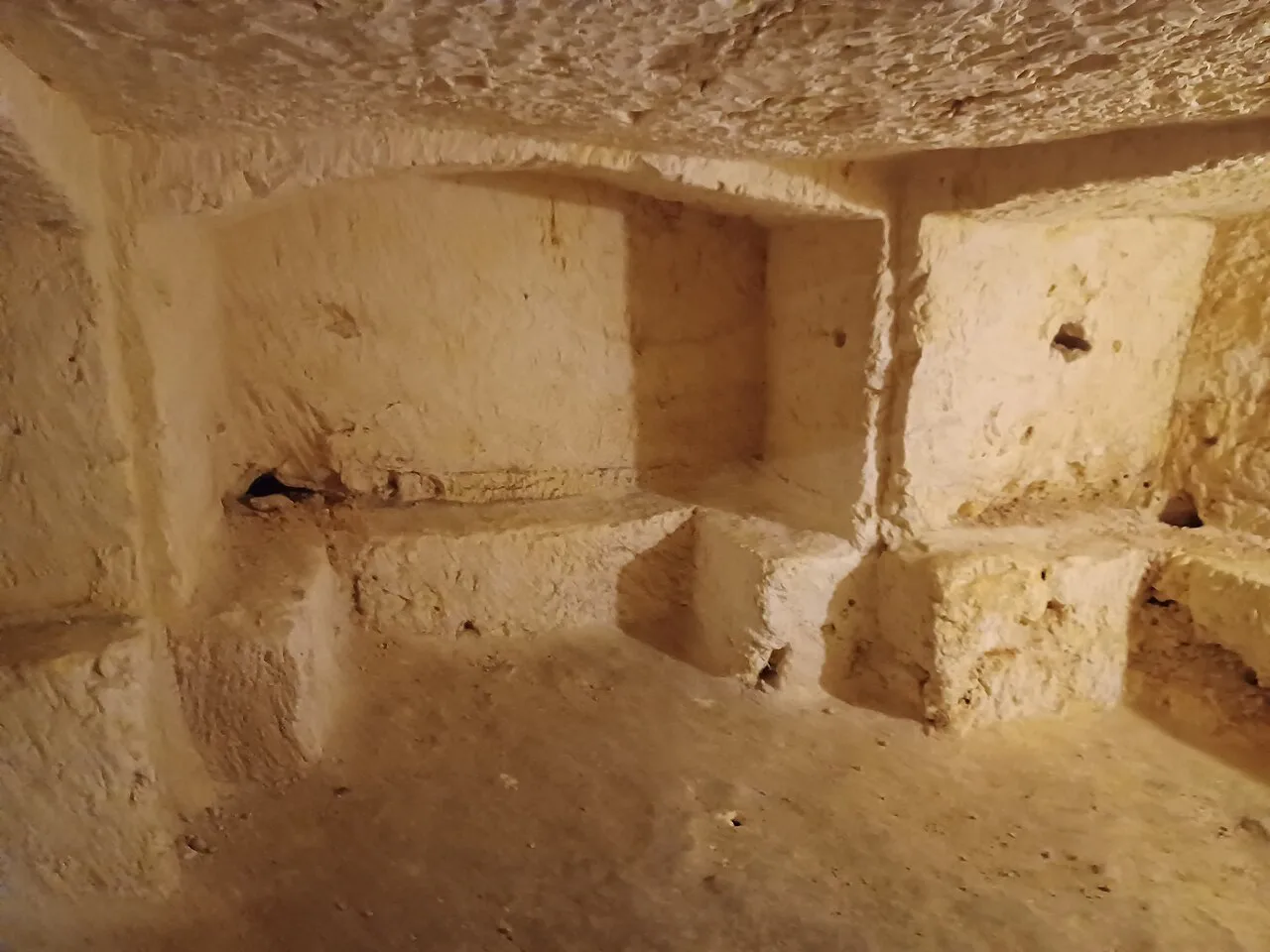
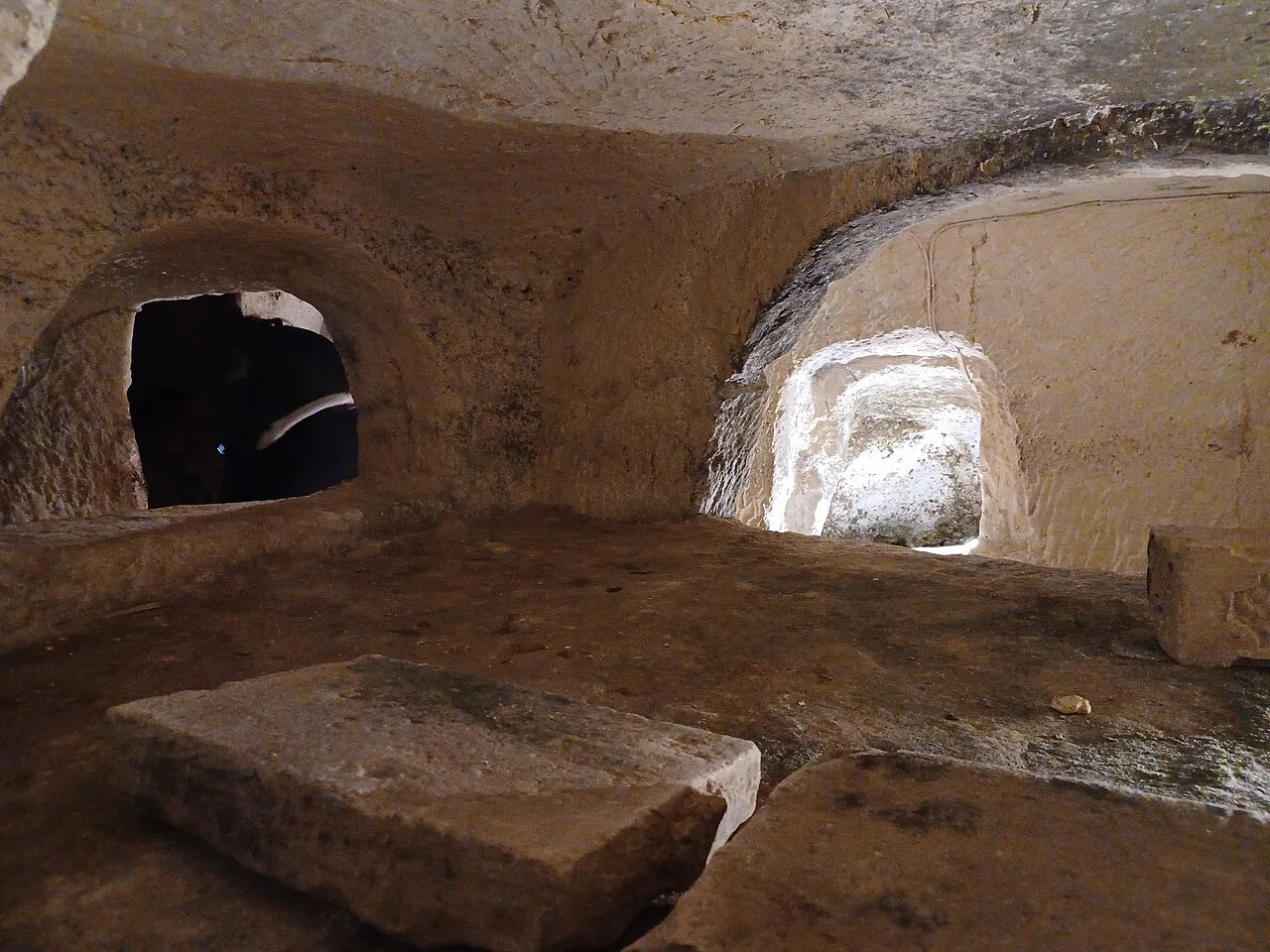
Past the catacomb entrance, with its display of tools, helmets and lamps, narrow winding corridors lead to rock-cut cells used as shelter by Maltese soldiers and civilians during the Second World War. Deeper in, you reach the Agape Table, a carved construction used by early Christians for commemorative meals near tombs.
The audio guide earns its small extra cost down here, where there is little labelling and the routes are dim and tight. Anyone uneasy in enclosed spaces can wait above while the rest of the party goes down, since the museum rooms and church remain accessible.
How much time to allow
Budget a good couple of hours, not a quick stop. Visitors who expect a single cave routinely find the complex much bigger than anticipated once the church, catacombs, shelters and museum are counted, and rushing the underground sections wastes the ticket.
Pair it with the town rather than squeezing it between two Mdina stops: a mid-morning start at the museum door leaves time for the church and the catacombs, then lunch in Rabat and Mdina in the afternoon. Check the desk's closing time when you go in so the underground sections do not get cut short.
Access and comfort: steps, low passages and a cramped Grotto
The visit involves a stone staircase down and narrow, uneven corridors in the catacombs, plus a small Grotto room; it is not a step-free experience. If you struggle with walking, dislike confined spaces or are very tall, judge whether the underground sections suit you before buying the ticket, and note that the church and square are easier on their own.
Wear shoes with grip for the worn stone steps, and carry a light layer since the cave and catacombs stay cooler than the square outside. Photography is generally permitted in the Grotto, though flash and tripods may be restricted, so follow any notices at the entrance.
Nearby in Rabat and Mdina for the same half-day
St Agatha's Church, Rabat is a short walk away and pairs naturally with the St Paul's visit, while the Domus Romana in Rabat adds a Roman townhouse floor to the same morning. Casa Bernard, Rabat, a furnished historic house open to visitors, suits anyone wanting an indoor stop after the underground sections.
Beyond the town, Buskett Gardens, Rabat gives you shade and open ground for a picnic, and the Verdala palace above it stands on the skyline; the President of the Republic of Malta uses the palace, so the gardens are the reliable part of that outing.
Is St Paul's Church worth the stop?
Yes, if you go in through the museum door on Triq il-Kulleġġ and give it two hours rather than twenty minutes. The ticket bundles the Grotto, the church, the catacombs, the shelters and the museum, which is what makes it worth the entry fee; the church alone is a ten-minute stop.
Skip it if steps, low corridors and a small cave are a problem, or if you have only an hour before a flight. Otherwise, go early, take the audio guide and walk up to Mdina afterwards.