
Verdala Palace: what you can see at Buskett

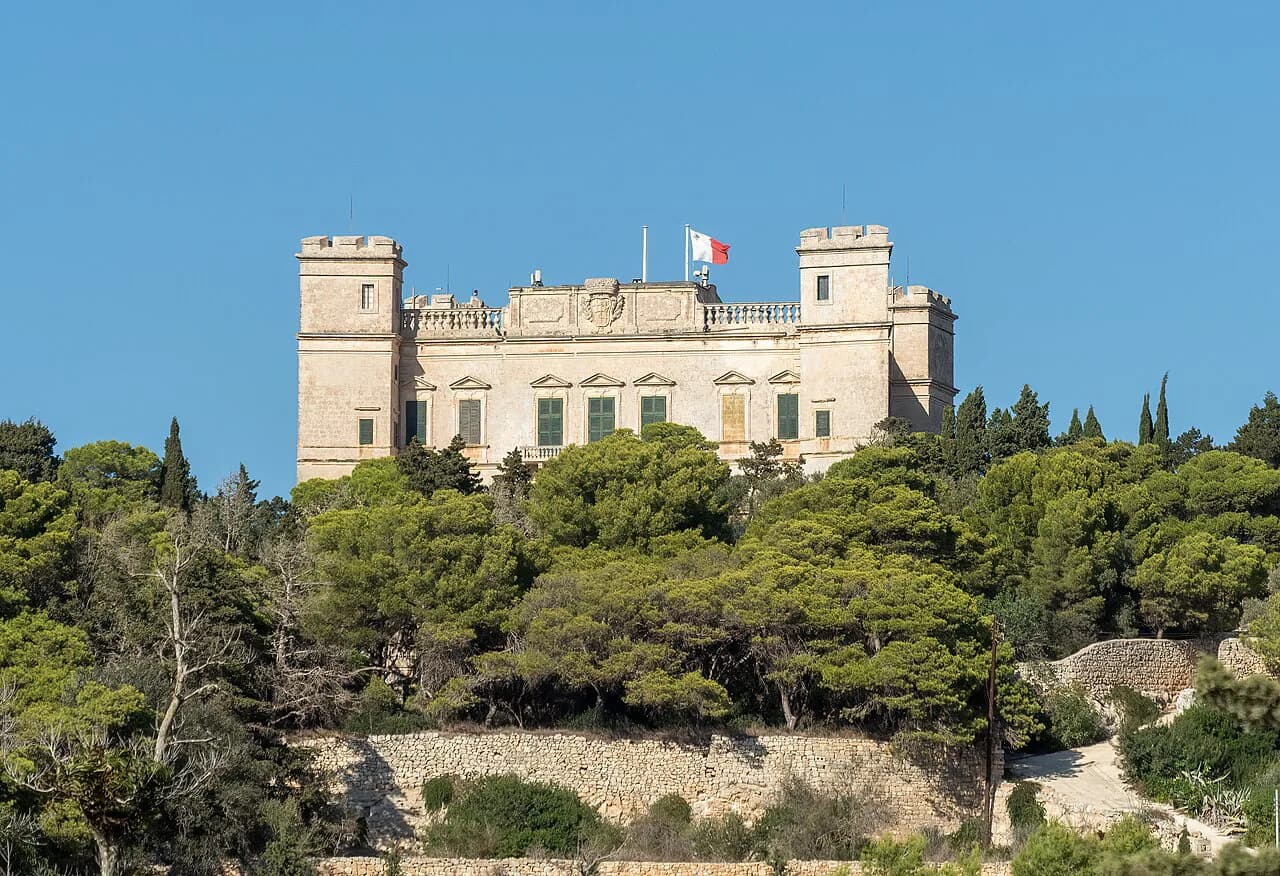
Verdala Palace is the summer residence of the President of Malta, a square, fortress-like building set in the Buskett woodland above Rabat and Siġġiewi. You come for the exterior and the pine woods around it rather than for a ticketed tour, so plan it as a short stop within a longer walk.
This page covers what the palace is, how it sits in the landscape, what is visible from outside, the interior features worth knowing about and how to build a visit around the woodland. The palace is a working presidential residence, so its official use rather than a visitor timetable governs what can be seen.
What Verdala Palace is
The palace serves as the summer residence of the President of the Republic of Malta, one of three sites assigned to the Office of the President when Malta became a Republic in 1974. It also hosts visiting heads of state as guests of successive presidents, so its calendar follows official use rather than a visitor timetable. Treat it as a working residence first and a monument second.
That status shapes how you visit. There is no evidence of routine public opening, so build your outing around what can be seen from the grounds and the surrounding woodland rather than around a room-by-room tour.

Where it sits: Buskett woodland above Rabat and Siġġiewi
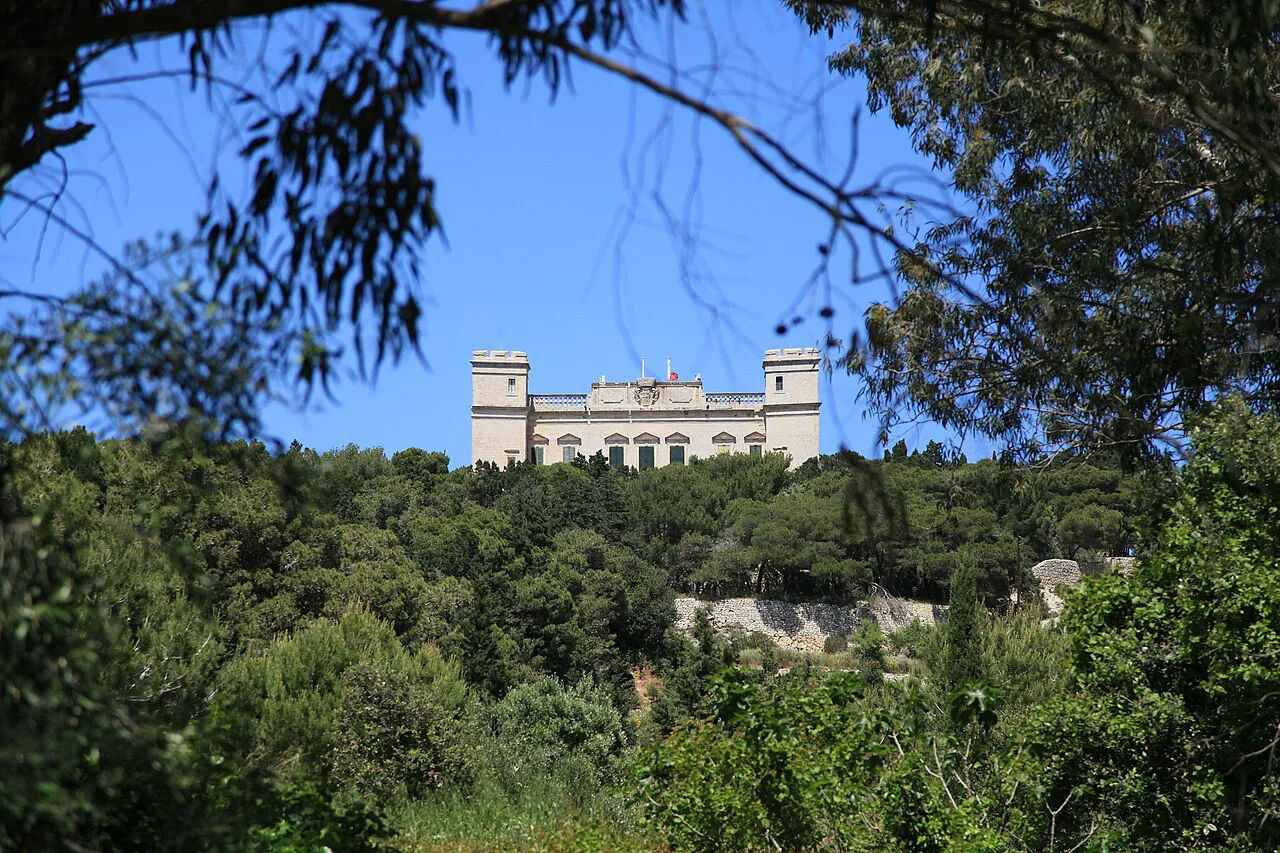
The palace stands at Buskett, a wooded area dominated by Aleppo pine, much of it planted during the British period under Governor Sir Arthur Borton. The plantation has since developed into a semi-natural, self-regenerating woodland whose conservation value led to the area being designated a Natura 2000 site.
A rehabilitation project covering about 6.8 hectares has planted native trees and undergrowth, removed invasive species and improved waste facilities, with the Scout Association of Malta involved in managing the site. In practice this means you are walking through managed woodland, not a formal garden with beds and labels.
The palace looks out over one of the greener landscapes in the Maltese Islands, which is the main reason to come. For a closer look at the woodland itself, the Buskett Gardens guide covers the paths and tree cover.

What you see from outside
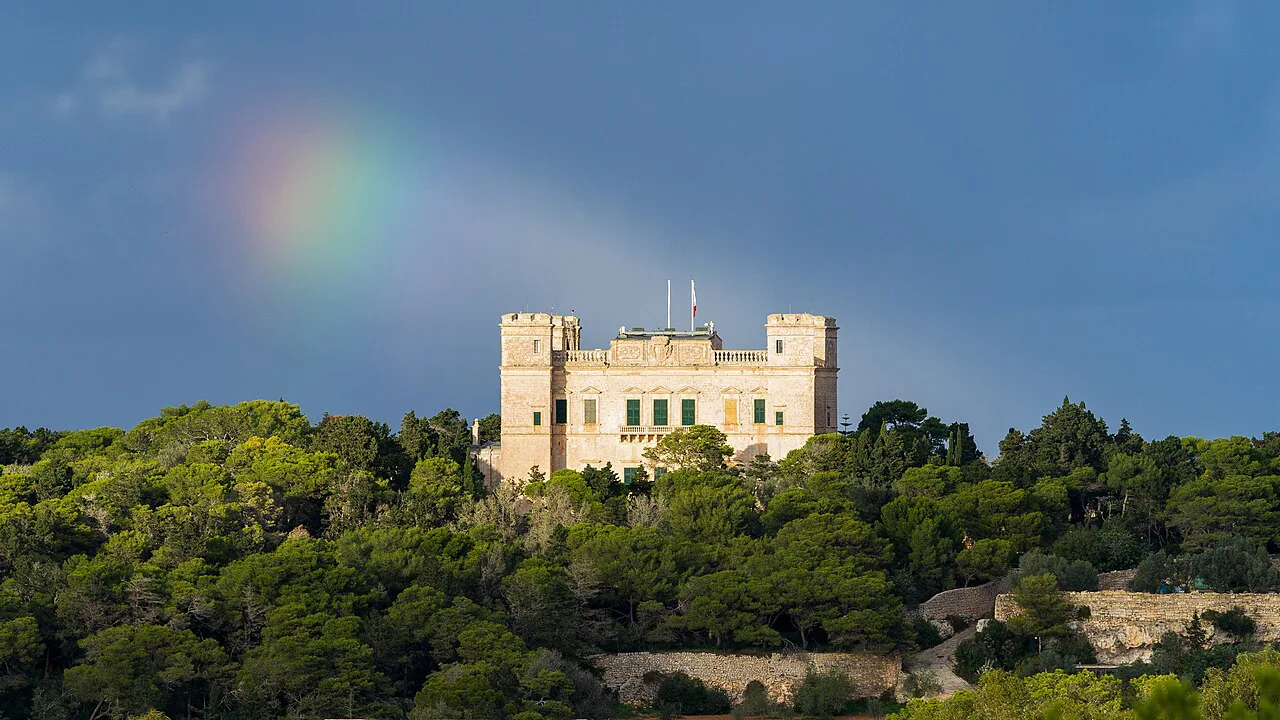
From the approach you get a square palace with four corner towers, one at each corner, that give it the outline of a fortress, and a dry ditch partly cut from the rock running around the building. The original two-storey structure had its ground floor reached from that ditch, which is why the profile reads as defensive even though it was built as a countryside retreat.
The perimeter in front of the palace is formed by attendants' quarters, stables and coach-houses added in the eighteenth century, so the approach passes service buildings before the main block. Photography from the outside is the realistic aim; there is no published viewing point or official exterior tour.
The building's shape and dates
The palace was built in 1586 for Grand Master Hugues Loubenx de Verdalle as a countryside retreat, to plans by the Maltese architect Gerolamo Cassar. A third floor was added later, during the magistracy of Grand Master António Manuel de Vilhena, along with the attendants' quarters, stables and coach-houses that frame the main grounds.
Knowing the sequence helps you read the facade: the lower block and towers belong to the original scheme, while the upper storey and the service range in front are later additions. That layering is the most interesting thing to look for when you are standing outside.
Inside, when access allows
The main hall carries a decorative scheme by Filippo Paladini, Verdalle's court painter, with episodes from the Grand Master's life at each end of the barrel-vaulted room and allegories on either side of each ceiling bay. An inscription above the entrance reads cedant curae loco, an invitation to set cares aside on entering.
The palace complex also includes a chapel dedicated to St Anthony the Abbot, whose titular painting is by Mattia Preti and dates from the early years of his permanent move to Malta, when he was working on the vault of St John's Co-Cathedral. These are the two interior features worth knowing about before you go, even if you never get past the door.
Whether you can go in
Because the palace is a presidential residence, interiors are occasional rather than routine. No published visiting schedule exists, so check with the Office of the President or a Maltese tourist information office before you set out if the hall and chapel are the reason for your trip.
If access is not available on your dates, the woodland and the exterior still justify the journey. Plan the day so the palace is one stop rather than the whole outing, and you will not be disappointed by a locked gate.
How to reach it
The simplest approach is by car or taxi from Rabat or Siġġiewi to the Buskett area, then on foot through the woodland to the palace. The lanes around Buskett are narrow and parking is limited, so an early start makes the arrival easier.
On foot, you can walk in from Rabat through the wooded paths, which is the more pleasant option in cooler weather. There are no bus route numbers or timetables here because services change; check the current network before relying on public transport.
How long to allow
Allow 20 to 30 minutes for the exterior and the immediate grounds, and two to three hours if you want to walk the Buskett woodland properly. The difference is the walking, not the building, so decide which you are doing before you leave the car.
Midday heat is the real constraint between late spring and early autumn, and the ground under the pines is uneven in places. A morning slot gives you shade and softer light for photographs of the towers and ditch.
What is nearby
Rabat is the natural base for the day, with Mdina a short distance beyond it. The Rabat Attractions: 11 Visitor Guides page sets out the catacombs, churches and museums that fill the rest of a half-day.
In Rabat itself, St Paul's Catacombs and St Paul's Grotto are the obvious pairings with a Buskett walk, both underground and cool at midday. Casa Bernard, a townhouse in the centre, suits a slower hour if you want something indoors.
St Agatha's Church and St Paul's Church are the other central stops if you are building a church-and-catacombs circuit around the palace trip. Further afield, Siġġiewi sits on the other side of the woodland and makes a sensible loop by car.
Practical points
Wear shoes with grip for the woodland paths, carry water, and avoid the middle of a summer day. The ditch and the uneven ground around the outbuildings are not suited to wheels, so plan accordingly if anyone in your party has mobility difficulties.
Before travelling, confirm whether any access arrangements apply on your dates, since the palace's official use takes priority. Everything else, including the walk and the views, can be planned without a booking.
Is Verdala Palace worth the detour?
Yes, if you treat it as a woodland outing with a palace at its centre. The exterior, the corner towers and the rock-cut ditch are worth half an hour, and the Buskett pines give the trip its purpose.
Pair it with Rabat's catacombs and Mdina for a full day, start in the morning, and confirm access before you go if the Paladini hall or the Preti altarpiece is what you came for.
Explore more Rabat guides
Frequently Asked Questions
Where is Verdala Palace?
It stands at Buskett, in the woodland above Rabat and Siġġiewi in Malta. The usual approach is by car or taxi to the Buskett area, then on foot through the woods.
Is Verdala Palace open to the public?
It is the summer residence of the President of Malta, and no routine public visiting schedule is published. Check with the Office of the President or a tourist information office before travelling if you want to see the interiors.
Where does the President of Malta live?
Verdala Palace serves as the summer residence of the President of the Republic of Malta, one of three sites assigned to the Office of the President. It also hosts visiting heads of state.