
Auberge d'Italie, Valletta: What to See at the MUŻA Building

Auberge d'Italie is a former knights' auberge on Merchants Street in the centre of Valletta, and it now holds MUŻA, the national museum of art. Allow roughly an hour to ninety minutes for the building and museum together, and treat it as an indoor stop when the midday heat pushes you off the streets. This guide covers where it sits, how to walk to it and which features are worth seeking out.
A langue auberge on Merchants Street
An auberge housed the knights of one langue, or national grouping, of the Order of Saint John, and each langue kept its own house in Valletta. The Langue of Italy acquired the present site on 28 April 1576, according to the museum's own building timeline, and the first construction phase was finished by 1580. The house you see today is a museum, listed by VisitMalta as the Auberge d'Italie attraction, so you are visiting a historic building whose rooms are given over to art.
MUŻA is described as an art museum at the Auberge d'Italie, formerly the National Museum of Fine Arts, which was housed at Admiralty House from 1974 to 2016. That history matters to what you see inside: the collection carries a national fine-art pedigree, while the building around it was adapted rather than rebuilt for the purpose. Expect the two to read together rather than as separate stops.

Where it sits in Valletta
The auberge faces Merchants Street, one of the straight grid streets running through the city centre, and the museum's timeline ties part of the first construction phase's façade to today's Pjazza de Valette. A second frontage on Merchants Street was under construction from 25 June 1593, so the building has more than one face to look at as you approach. The museum's own milestone list uses the spellings 'Pjazza de Vallette' and 'Pjazza de Valette' for the square associated with that early façade.
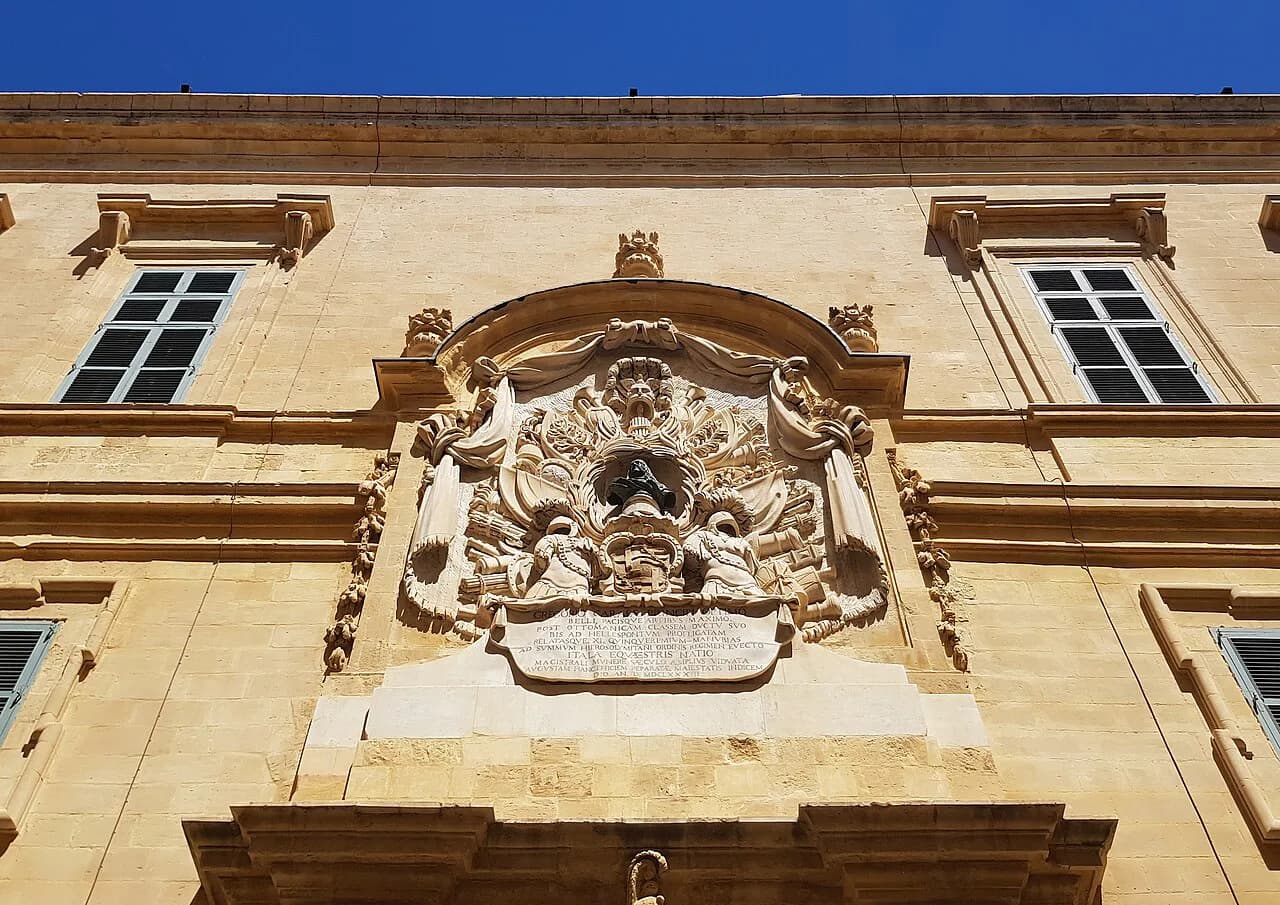
The building sits within the street grid rather than on an open waterfront bastion, so the courtyard gives the clearer sense of its scale than the street elevation. Look for the bust over the main doorway as you come along the pavement, then step inside for the wider perspective. My pick is to treat the interior, not the façade, as the main event here.

How to reach it on foot
The museum's venue listing gives the address as Auberge D'Italie, Merchants Street, and the museum's timeline ties part of its first façade to Pjazza de Valette. Approach by the street grid and the Merchants Street address rather than expecting signposted wayfinding from the city gate.
If you are heading for the harbour-side gardens afterwards, walk back down through the centre and finish at Upper Barrakka Gardens Valletta, where the terrace looks over Grand Harbour. Do that in the late afternoon rather than at midday, and the auberge becomes a sensible first indoor stop of the day.
How long to allow
My suggestion is an hour to walk the principal rooms and read the building's phases, and ninety minutes if you want longer with the collection and the courtyard. Add a further half hour if you want to continue along Merchants Street, which holds other historic houses. The museum is an indoor stop, so it works best as cover during the hottest part of the day rather than as a quick five-minute look-in.
What survives to see
The courtyard is the clear highlight of the building itself: a central space with a well, and a triumphal arch topped by a statue and coat of arms, which is how visiting guests first met the house. Around it, the halls carry the names of the knights' daily life, and the Camerone was the Italian Knights' principal refectory or dining hall. Look up and around rather than only at the objects on display.
The Community Space belongs to the first construction phase and holds a marble inscription commemorating Fra Gregorio Carafa's Victory, which makes it a useful place to connect the name on the façade with the room you are standing in. Carafa was elected Grand Master on 11 September 1680, and the Italian Langue commissioned a bust with a decorative backdrop over the main doorway in his honour. The bust is therefore a dated feature of the entrance rather than decoration of uncertain origin.
Original kitchen evidence has been found in the building, including the marks of the hood that stood over the hearth, the flagstone floor and cupboards built into the thickness of the walls. A layer of soot and grime still covers the high walls of that area, so the working side of the auberge survives alongside the ceremonial rooms. If you visit only one interior detail after the courtyard, make it this one.
Reading the building's phases
The building was constructed in stages rather than to a single design, and the museum's timeline records the square now known as Pjazza de Vallette being built up by the Langue in 1629. Extensive renovation works concluded on 10 September 1669, including work on the main façade, attributed to the architect Mederico Blondel and most likely funded personally by Carafa. Seeing those dates together explains why the frontages and internal levels do not read as one coherent build.
The Scala Grande, the main staircase that once connected all floors, was demolished in 1850 and replaced by a much smaller stairway linking Melita Street to the top floor. Its loss is one of the more tangible alterations, since the surviving circulation no longer matches the original plan. Read the entrance sequence with that in mind and the building's archaeology becomes easier to follow.
Later history left its marks too: the Valletta Museum opened in the building in 1922 under Sir Themistocles Zammit and was officially inaugurated on 19 November 1925, and the auberge took two direct hits on 7 April 1942. The Notarial Archives had been relocated to the top floor from 13 June 1850, and they suffered extensive damage in that raid. These are documented milestones rather than legend, and they explain the composite fabric you walk through.
Tickets, opening hours and booking
Admission charges, opening days and any booking arrangement are not fixed in the sources used here, so confirm them with MUŻA before you travel, as these are the details most likely to change between seasons. The building's own history and room names stay broadly constant, which is why it is worth reading up on the architecture first and confirming the practical side last.
Nearby on the same walk
Merchants Street itself continues past other historic houses, so walk a stretch of it in both directions before turning off. Pjazza de Valette is close by and forms part of the building's own story, which makes it a natural pause rather than a separate outing. For a wartime contrast to the knights' Valletta, the Lascaris War Rooms sit down toward the bastions and take you underground into the harbour defences.
If you have time for one more stop at the harbour edge, the Saluting Battery below the Upper Barrakka terrace adds an open-air view to set against the auberge's enclosed courtyard. It works well as a closer for a half-day in the centre rather than as a first stop.
Is the auberge worth an hour of your Valletta day?
Yes, if you want one building that explains how Valletta was organised by langue while giving you a museum collection in the same visit. The courtyard, the Carafa bust and the surviving kitchen fabric are the specific things to seek out, and an hour covers them comfortably. Pair it with a walk along Merchants Street and a harbour-side finish, and confirm admission and hours on MUŻA's plan-your-visit page before you set out.
Explore more Valletta guides
- Auberge de Castille
- Basilica of Our Lady of Mount Carmel, Valletta
- Casa Rocca Piccola
- Fort St Elmo and the National War Museum, Valletta
- Grandmaster's Palace, Valletta
- Hastings Garden, Valletta
- Lower Barrakka Gardens, Valletta
- National Museum of Archaeology, Valletta
- National War Museum at Fort St Elmo, Valletta
- St John's Co-Cathedral, Valletta
- St Paul's Pro-Cathedral, Valletta
- Teatru Manoel
Frequently Asked Questions
What is an auberge in Malta?
An auberge was the house of one langue, a national grouping of the Knights of Saint John, in Valletta. Each langue kept its own auberge, and the Langue of Italy acquired the site of the Auberge d'Italie on 28 April 1576.
Do I need to dress modestly at the Auberge d'Italie?
Church dress expectations do not apply here, because the building is a museum rather than an active church. Wear what you would for any indoor gallery, and keep in mind that the courtyard is open to the sky.
How does the auberge relate to MUŻA?
MUŻA is the art museum housed inside the Auberge d'Italie on Merchants Street. The museum was formerly the National Museum of Fine Arts, which was at Admiralty House from 1974 to 2016 before the move to the auberge.