Ġgantija Temples, Gozo: What to See and How Long It Takes
Plan a visit to Ġgantija's two megalithic temples in Xagħra, Gozo: what stands there, how long to allow, what the ticket covers and how to get there.
On this page
Ġgantija is a short visit, not a half-day: two megalithic temples standing side by side inside one boundary wall on the Xagħra plateau in Gozo, with a walk-through of roughly 20 minutes once you are past the entrance. Allow longer for the visitor centre and the climb up from the village. This guide covers what actually stands on the site, the two limestones the builders used, ticket bands and opening hours, the buses from Victoria and Mġarr, and how Ġgantija compares with Malta's other temple complexes.
What Ġgantija is
Ġgantija consists of two adjacent temples joined by a common wall, each with its own entrance, on the edge of Xagħra in eastern Gozo. Archaeologists date the construction to between 3600 and 3200 BCE, during the phase of Maltese prehistory that carries the site's name. The name means "place of giants", and the local story credits a giantess called Sansuna with building it while nursing her child.
The complex is one of the Megalithic Temples of Malta, a group inscribed as a UNESCO World Heritage site in 1980. That listing matters when you are planning: Ġgantija is not an isolated ruin but part of a wider set of temple sites, so it rewards a little context before you arrive. If you want the full picture of what the islands hold, work through our guide to the megalithic temples Malta preserves, which sets Ġgantija alongside the others.
Why the date matters
Ġgantija was raised around 3600 BCE, which places it roughly a thousand years before the sarsen circle at Stonehenge and a thousand years before the first Egyptian pyramid. It is among the oldest free-standing stone temples anywhere, built by a farming community working without metal and without the wheel. The comparison is the reason many travellers put it on a Gozo itinerary at all.
One honest caveat: the ritual complex at Göbekli Tepe in Turkey, from around 9500 BCE, predates it, so Ġgantija is the oldest free-standing stone temple rather than the oldest structure of any kind. Keep that in mind when you read the claim repeated elsewhere. For the wider story of the islands before written records, our Malta prehistory background is the place to start.
The layout on the ground
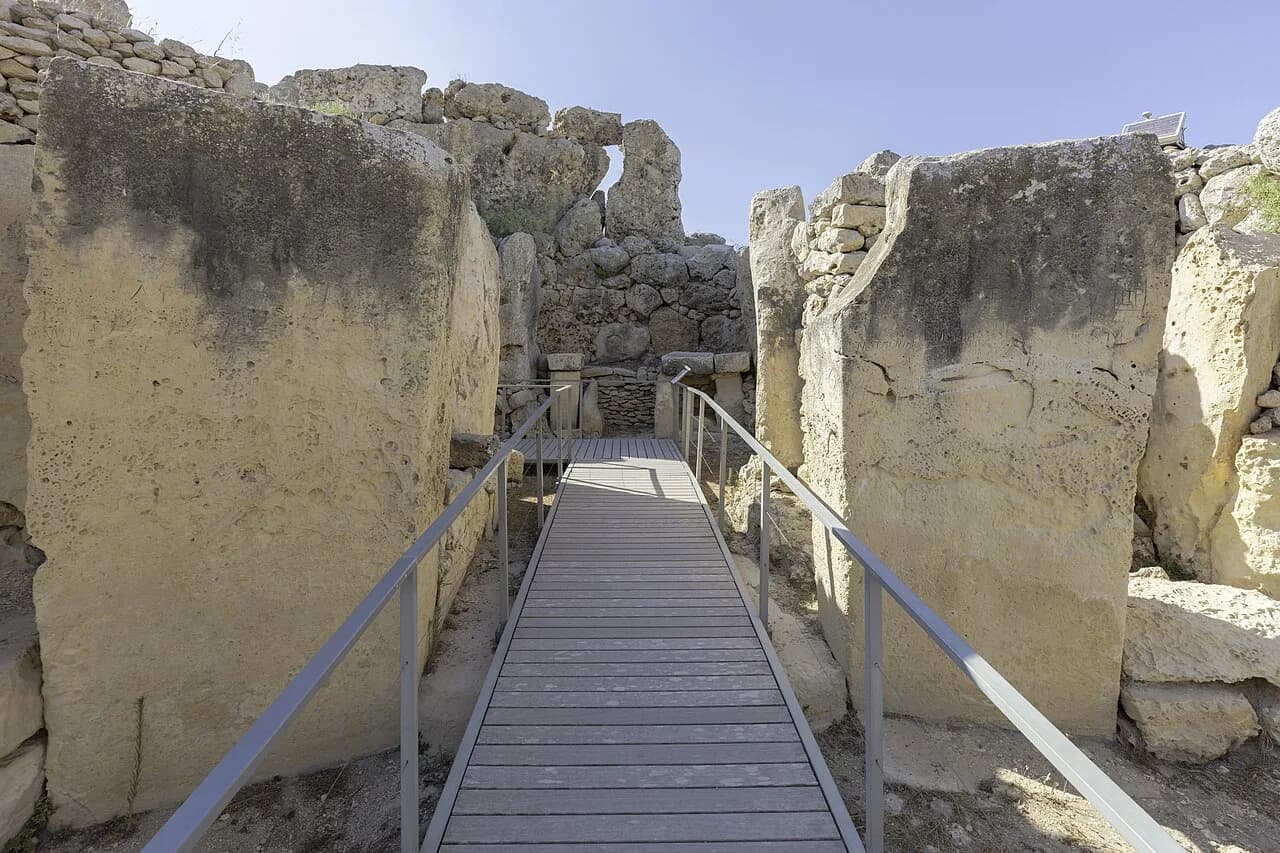
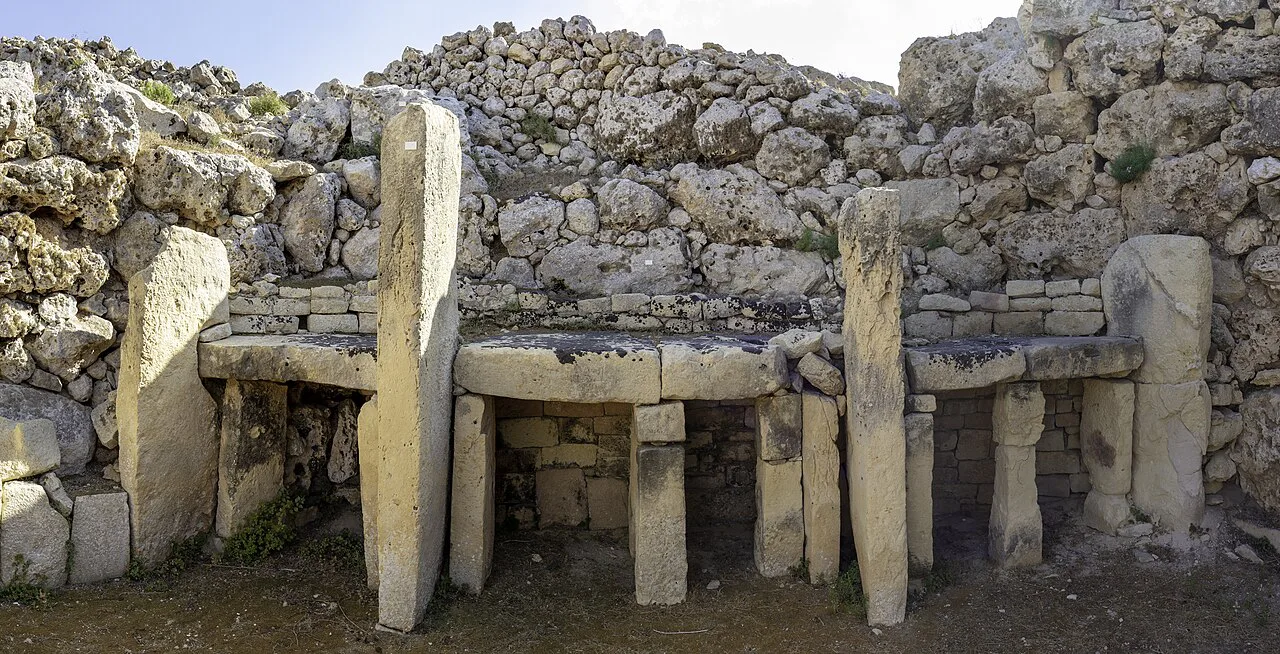
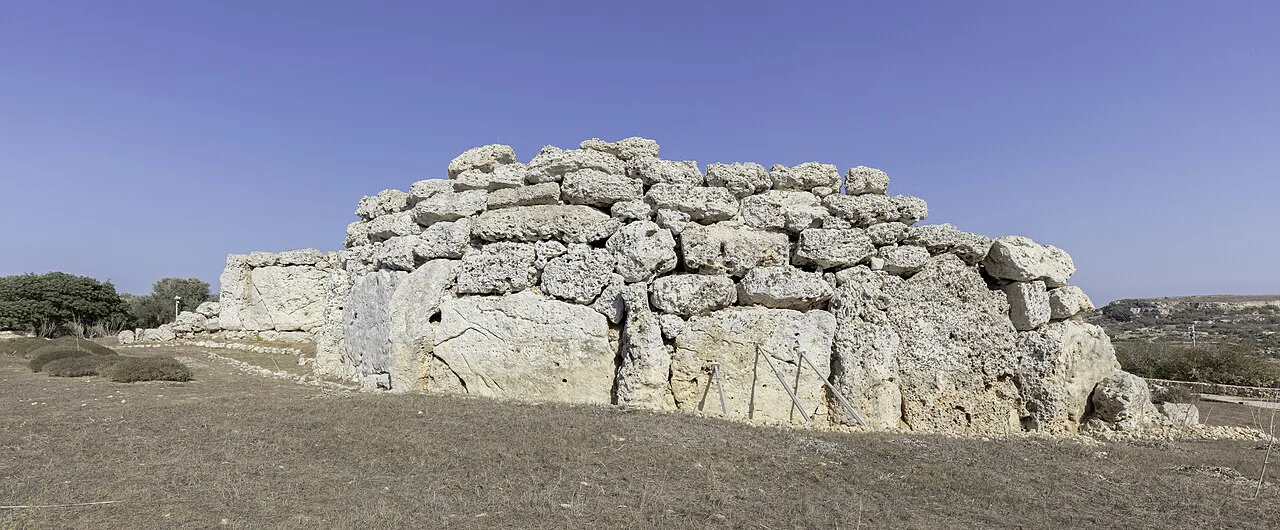
You approach across a large forecourt onto a curving concave facade shared by both temples, wrapped in a single boundary wall that still rises about six metres. Entry is through a trilithon doorway, two uprights capped by a lintel, which leads into a central corridor opening onto a clover-leaf arrangement of rounded chambers, or apses; the larger, older temple has five. The plan is unlike anything else you will walk through on the islands, and it pulls you inward through one curved room after another.
The builders used two local stones with clear purpose: hard coralline limestone for the structural megaliths and outer walls, and softer globigerina limestone, easier to carve, for the inner altars decorated with spirals and drilled pits. Some of the standing stones are over five metres tall and weigh up to fifty tonnes. Look for the change in colour and texture between the two limestones as you move from the outside wall into the chambers.
How long you need
The temple area itself is small: you can walk through the whole site in about 20 minutes. Add time at the visitor centre before you go in, and you have a comfortable hour rather than a half-day. Treat Ġgantija as one stop on a Gozo day rather than the day itself, and pair it with Xagħra village or Victoria.
The site sits on the exposed Xagħra plateau, so expect little shade and strong sun in the middle of the day during the warmer months. Going early or later in the afternoon makes the stones easier to look at and the reading panels easier to concentrate on. Water and a hat are worth carrying even for a short stop.
Tickets and what the ticket covers
One ticket covers both Ġgantija and the nearby Ta' Kola Windmill, an 18th-century mill whose ground floor holds the miller's workshop with its tools and whose first floor has the family's restored living quarters. That pairing is worth knowing so you do not pay twice: build the windmill into the same outing. Official admission prices and current bands are published by Heritage Malta, and the site's own page is where to confirm them before you travel.
Opening hours are published as daily from 10:00 to 18:00, and the ticket covers adult, youth and senior, and child bands. Treat both the hours and the bands as published information rather than a promise for your date, and check before a special trip. Ġgantija is a single compact site, so plan around your transit and the day's heat, and if the Ħal Saflieni Hypogeum is also on your list, its limited timed slots make booking well ahead essential there.
Getting there from Victoria and Mġarr
Ġgantija sits near the centre of Xagħra, a few minutes' drive from Victoria. Bus 307 runs from Victoria to the town roughly every hour, and bus 322 stops about every hour and a half on its run from Mġarr Harbour and Ramla Bay. The stop is less than 30 metres from the main entrance, which makes the site one of the easier temple complexes to reach without a car.
Driving brings its own trade-off: there is no parking at the entrance, but you can park free on the streets of Xagħra and walk the last few minutes. Arriving mid-morning gives you a better chance of finding a space near the centre of the village. If you are coming from Malta, allow for the ferry crossing and the drive up from Mġarr on top of the bus or parking time.
Artefacts and what else is nearby
Objects found at the temples are held at the Victoria Archaeological Museum, so a stop in Victoria adds context that the bare stones cannot give you. In Victoria itself, the Citadel is the obvious companion visit. The Rotunda of Xewkija, Ramla Bay and Victoria all lie within a few kilometres of Ġgantija, which makes a cluster of stops realistic in one day.
Ġgantija compared with Ħaġar Qim and Mnajdra
If you are choosing one temple complex, think about what you want from it. Ġgantija gives you a compact pair of temples with a shared facade and a very short walk, wrapped in a museum and a ticket that also covers a windmill. Ħaġar Qim and Mnajdra on Malta's south coast are a different day out, reached from a different base, and suit travellers staying on the main island rather than in Gozo.
For more temple variety on Malta itself, the Tarxien temples are the handiest from Valletta and sit close to the bus network. Skorba temples and Ta' Ħaġrat are smaller and quieter, and work well if you have already seen the headline sites. If you are staying south, Għar Dalam pairs a cave with a museum and makes a different sort of prehistoric stop.
Is Ġgantija worth the stop on a Gozo day?
Yes, if you are already on Gozo and want to stand inside something genuinely hard to explain. It is a short, low-effort visit with a combined ticket that adds a windmill, and the stones themselves need no interpretation to impress. Do not build a whole day around it.
Check the current hours and admission bands before you travel, then decide whether you go early to dodge the plateau heat or later to fit the windmill into the same ticket. Either way, keep the visit short and let Victoria and the museum do the rest of the work.
Frequently Asked Questions
Is Ġgantija older than Stonehenge?
Ġgantija was raised around 3600 BCE, roughly a thousand years before the sarsen circle at Stonehenge and the first Egyptian pyramid. It is among the oldest free-standing stone temples anywhere, though the ritual complex at Göbekli Tepe in Turkey predates it.
Where is the "fat Lady" from Ġgantija?
Sculptural figures from Malta's temple period are generally seen in museum collections rather than on site. Historical artefacts found at Ġgantija are held at the Victoria Archaeological Museum, so that is where to look for temple-period material from this part of Gozo.
Do I need to book Ġgantija in advance?
Ġgantija is a compact site and does not rely on the limited timed slots that make the Ħal Saflieni Hypogeum sell out weeks ahead. Check the official Heritage Malta page for current hours, admission bands and any booking advice before you travel, particularly if you are making a special trip from Malta.
Sources
- Ġgantija: The Oldest Temple Standing, Built by 'Giants' — How a Neolithic island people on Malta — with no metal and no wheel — raised the oldest free-standing stone temples on Earth a thousand years before Stonehenge or the pyramids, moving fifty-tonne blocks on stone balls into clover-leaf sanctua
- Ġgantija: Where humans first spoke to the sacred - Pilgrimaps
- Ġgantija, Gozo - all you need to know
Notes for your Malta trip
Optional updates when we add or correct a Malta or Gozo guide.
You might also like
Continue reading
More guides you'll find useful