Malta Prehistory: Temples, Tombs and Where to See Them
Malta's prehistoric temples, the Hypogeum, cart ruts and the museums that explain them: what each site is and which to see first.
On this page
Malta's prehistoric sites fall into three visitable groups: the open-air megalithic temples, the rock-cut Ħal Saflieni Hypogeum, and the museum collections that hold the statuettes and carvings found in them. Start with Ħaġar Qim and Mnajdra for the architecture, add Tarxien for its carvings, and see the objects themselves at the National Museum of Archaeology in Valletta. This guide orders the temple period by construction date, names what to look for at each monument, and sets out how long the sites take and where the honest constraints lie.
What Malta's prehistoric period covers
The islands were settled as long ago as 5200 BCE, well before the Phoenicians, Romans and Moors who later held them, and the first arrivals appear to have come from Sicily. Early settlers lived in caves such as Għar Dalam before building huts, then farmed cereals and raised livestock.
That farming society raised the megalithic temples, and the temple-building culture came to an end around 2500 BC. After a gap of several decades the islands were settled again by Bronze Age people, who built smaller dolmens and cremated their dead.
The surviving evidence for the temple centuries is architectural and figurative: curved façades, carved altars, and clay statuettes that emphasise female features and have been linked to a fertility cult. Human bones from tombs and the Hypogeum point to the same society burying and worshipping in parallel.
The temple period in order
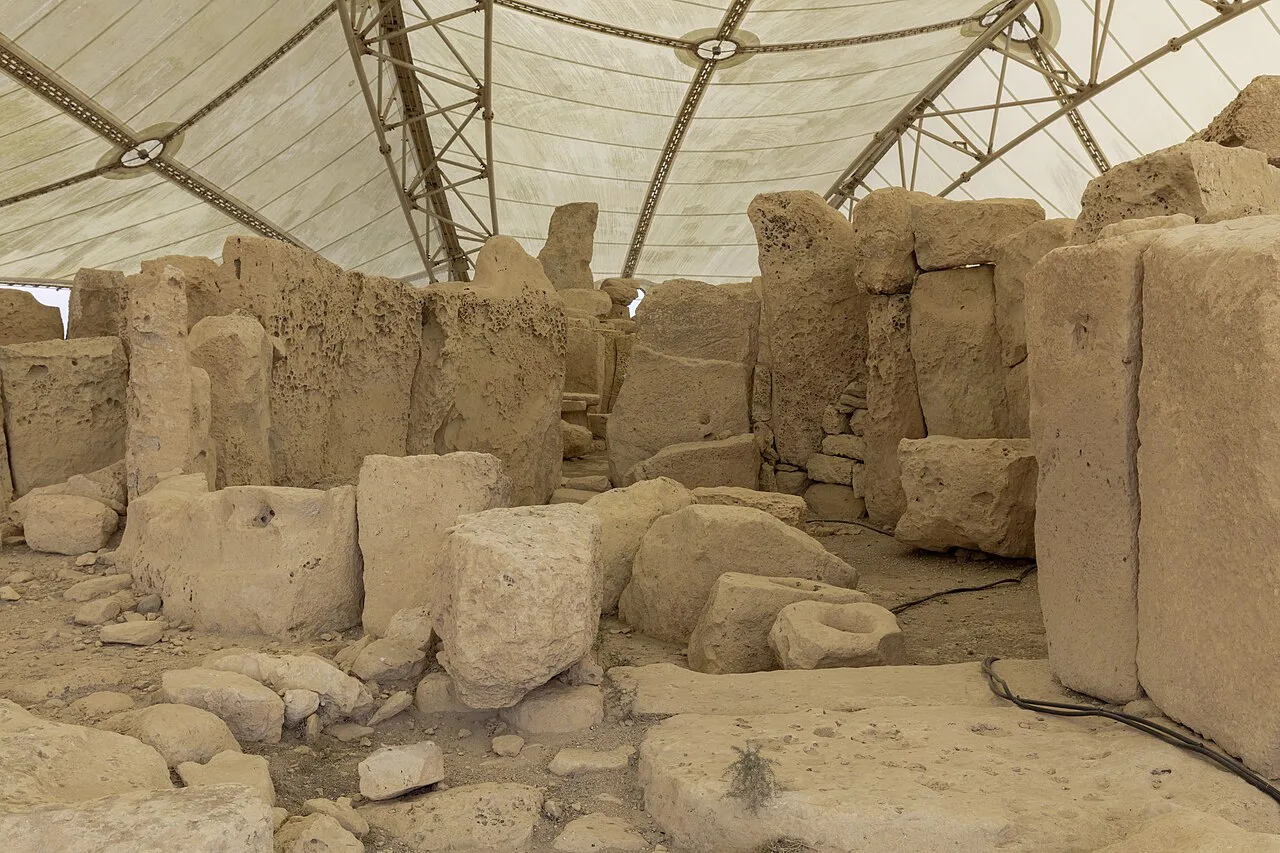
Sequencing the temples by date makes a visit legible. Ta' Ħaġrat's larger building belongs to the earliest phases of megalithic construction, 3600–3200 BCE, and the main Ħaġar Qim temple was built in the same window. Mnajdra's North Temple is contemporary with Ħaġar Qim, while its South and Central temples were built between 3150 and 2500 BCE.
Tarxien's four attached structures were raised at the height of the late Neolithic, between 3250 and 3000 BCE, with its richly decorated South Temple built between 3000 and 2500 BCE. Read in this order, the sites show a tradition tightening and elaborating rather than a scatter of unrelated ruins.
Skorba sits outside the monumental circuit but matters for the sequence: prehistorical pottery found there resembles wares from Italy, which is why the first settlers are thought to have crossed from Sicily. A dedicated page covers the Skorba temples and what survives of them.
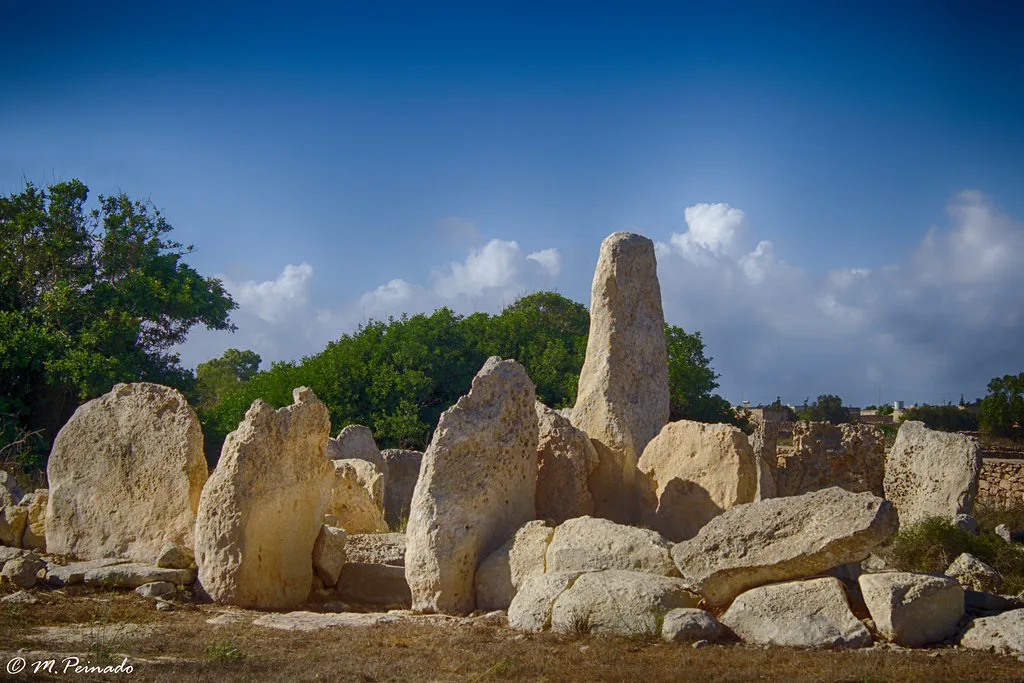
Ħaġar Qim: the concave façade and the trilithon entrance
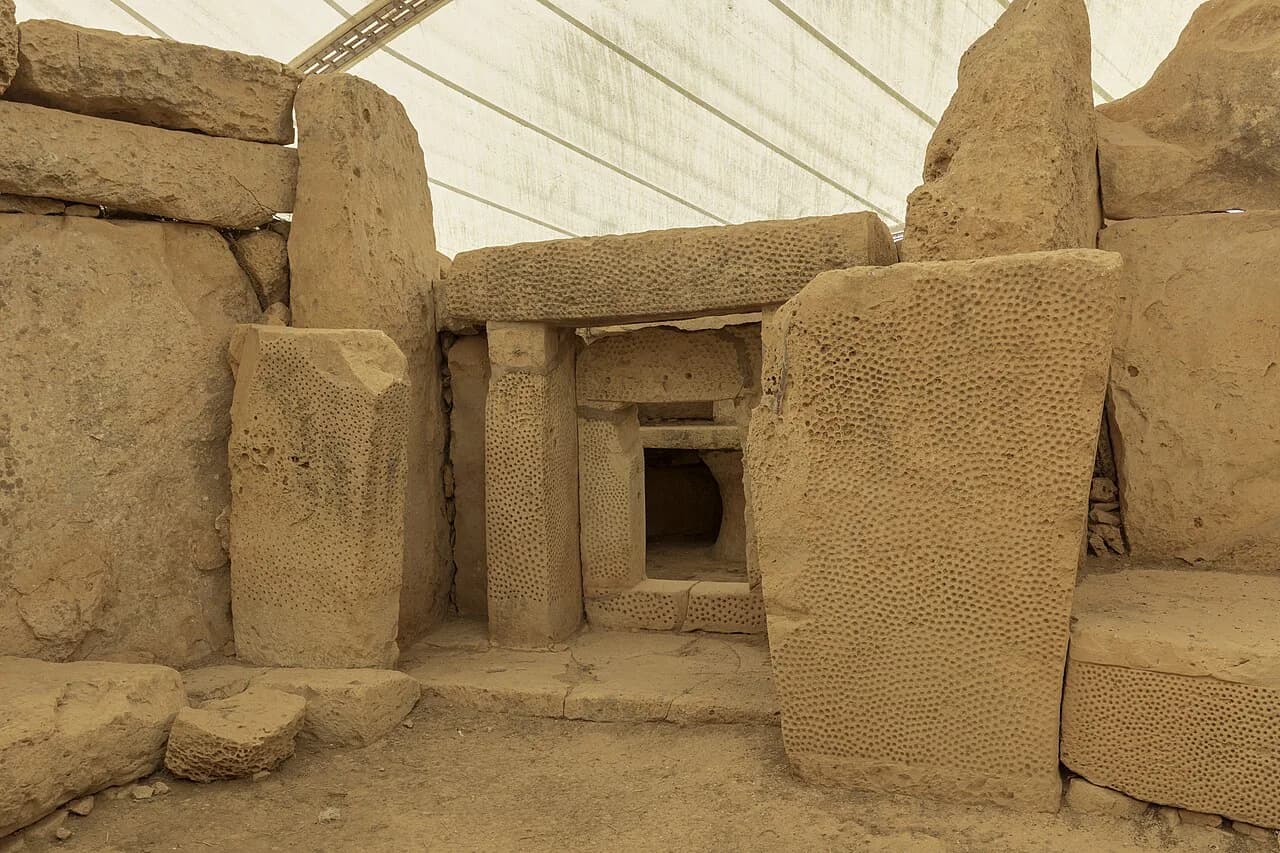
The main temple at Ħaġar Qim is entered through a monumental concave façade facing southeast, approached across an oval forecourt. The doorway itself is a trilithon: two uprights either side of a threshold carrying a horizontal lintel, a feature shared by many temples on the islands. Look up at the corner slabs, which are notched into the massive uprights, and at the external wall, where the largest megaliths stand without a structural job that smaller blocks could not do.
Mnajdra lies about 500 metres from Ħaġar Qim, on a rugged stretch of the southern coast, so the two belong in one outing. Give the pair a half-day rather than an hour: the walk between them is short but the exposed ground and the scale of the walls slow you down.
Mnajdra: three temples around a common forecourt
Mnajdra comprises three separate buildings entered from a common forecourt, part of it paved, with stone benches lining the concave façade of the South Temple either side of the central entrance. The South Temple was designed to receive sunlight at particular points during the spring and autumn equinoxes and the summer and winter solstices, so its orientation is the thing to notice.
The Central Temple sits slightly higher, built on an artificial stone platform levelled against the South Temple wall. On the taller upright to the left of the right-hand entrance, an engraving of a temple façade is cut into the stone — a small detail that repays a slow second pass round the forecourt.
Tarxien: four structures, carved altars and a colossal statue
The Tarxien complex is four separate but attached buildings on ground used over several millennia, and its value lies in the fine stone carvings and the artefacts recovered there. The South Temple is the most highly decorated of the islands' megalithic buildings, with relief sculpture and the remains of a colossal statue that appears to be the oldest monumental anthropomorphic representation known from Mediterranean prehistory.
Look for the decorated altar in the South Temple, where a mensa and niche echo the enclosed trilithon structure found at other Maltese temples. Tarxien is the site to prioritise if you have already seen the coastal temples and want the carving rather than the setting.
Ta' Ħaġrat at Mġarr: two small temples in Coralline limestone
Ta' Ħaġrat stands in Mġarr in northwest Malta and is smaller than most other sites of its kind, which makes it a quick, low-effort stop. The complex is two well-preserved structures built entirely of local Coralline limestone, the larger dating from 3600–3200 BCE.
Inside the West Temple, a monumental façade carries a stone bench along its length, and the central doorway, restored in 1937 with its massive lintel put back in position, opens onto a courtyard of roughly 2.5 by 4.5 metres with a raised kerb and three semi-circular chambers. The East Temple was probably built later on a four-apse plan and links directly to the West through a doorway; a sculpted scale model of a megalithic building was reportedly found there.
Ġgantija on Gozo and where Skorba fits
Ġgantija on Gozo is one of the megalithic wonders named alongside Ħaġar Qim and Mnajdra, and it is the reason a temple circuit can stretch across two islands. Treat it as a separate Gozo day rather than squeezing it into a Malta itinerary, because the crossing and the site itself both take time out of the day.
Skorba adds the earlier chapter: its pottery is the evidence for settlers arriving from Sicily, and it belongs on the list if you want the full arc rather than the showpieces. The Megalithic Temples of Malta guide pulls the whole circuit together if you are choosing between sites.
Rock-cut tombs and the Ħal Saflieni Hypogeum
The Hypogeum is a rock-cut cemetery and sanctuary rather than a built temple, and the bones of roughly 6,000 to 7,000 individuals were found in its side chambers. It has been suggested that the above-ground temples copied the rock-cut tombs at Xemxija, which were in use around 3100 BC, with the dead placed crouched on one side and sometimes sprinkled with red ochre; the Hypogeum makes that link between tomb and temple explicit.
Because it is an enclosed underground site with tightly limited capacity, plan it early in your trip planning rather than leaving it to the last day; the Hypogeum page sets out what a visit involves.
Cart ruts and the Bronze Age
The only archaeological evidence from the period after the temple society vanished is the cart tracks, or cart ruts: prehistoric channels thought to have been worn into the soft limestone by wooden-wheeled carts. They run in several places across the islands, including the stretch between Dingli Cliffs and Buskett known as Clapham Junction.
Pair the ruts with a cave visit if you are tracing the whole sequence, since Għar Dalam covers the earliest cave-dwelling phase. Neither needs long, and both break up a day of temple walls with something more landscape-scale.
Where to see the finds: the National Museum of Archaeology
The objects that make the temples readable are in Valletta, in the National Museum of Archaeology. Its collection includes the Sleeping Lady and the temple-period statuettes, along with the gigantic mother goddess figure found in the temples.
Visit the museum either before the sites, to learn the forms you will see in stone, or after, to match statuettes and carved fragments to the chambers they came from. The statuettes carry the fertility-cult reading of the temples, with emphasised female features and shell fragments set into one figure.
How long the sites need and how to group them
Group the coast first: Ħaġar Qim and Mnajdra sit 500 metres apart and fill half a day. Add Tarxien on a different half-day, since its carvings need unhurried attention, and keep Ta' Ħaġrat at Mġarr for a short stop on the way to or from the north.
Put the national museum in Valletta on a separate slot rather than bolting it onto a temple morning, and give Ġgantija its own Gozo day. For a wider choice of sites and how they connect, the Megalithic Temples of Malta guide sets out the options.
The trade-offs: heat, Hypogeum capacity and Valletta crowds
The open temple sites are exposed, with little shade on the rugged coastal ground around Mnajdra and the oval forecourt at Ħaġar Qim, so start early and avoid the middle of the day in summer. The Hypogeum is the opposite problem: as a limited-capacity underground site it rewards planning weeks ahead.
In Valletta, the national museum shares the city with cruise-day crowds, so time the museum for a quieter slot and keep the temple days for the coast. That split keeps the two halves of a prehistoric trip from competing for the same hours.
Which prehistoric site should you see first?
See Ħaġar Qim and Mnajdra first: they deliver the temple architecture, the trilithon entrance and the solstice alignment in one half-day on the coast. Add Tarxien for carving and the museum in Valletta for the objects, then Ġgantija on Gozo if you have a second day.
Explore more Malta guides
Frequently Asked Questions
What are the oldest ruins in Malta?
The megalithic temples are the headline prehistoric monuments, with the main Ħaġar Qim temple built between 3600 and 3200 BCE and Ta' Ħaġrat's larger building from the same phase. Mnajdra's South and Central temples followed between 3150 and 2500 BCE, and Tarxien was raised between 3250 and 3000 BCE.
Who built the megalithic temples of Malta?
The temples were raised by the islands' Neolithic farming society, which grew cereals, raised livestock and made clay fertility figures. That temple-building culture disappeared around 2500 BC and was replaced, after a gap, by Bronze Age settlers who built smaller dolmens and cremated their dead.
Can I see prehistoric finds without visiting the temples?
Yes. The National Museum of Archaeology in Valletta holds the Sleeping Lady and the temple-period statuettes, so you can see the objects in the city even on a day when the open sites are impractical.
Sources
Notes for your Malta trip
Optional updates when we add or correct a Malta or Gozo guide.
You might also like
Continue reading
More guides you'll find useful