Ħaġar Qim and Mnajdra: Tickets, Transport and What You'll See
Plan a visit to Ħaġar Qim and Mnajdra near Qrendi: what the two temples contain, how one ticket covers both, and how to get there by bus or car.
On this page
Ħaġar Qim is a hilltop complex of megalithic buildings on the south-west coast of Malta, near Qrendi, and your ticket also covers Mnajdra, 500 metres downhill towards the sea. Allow about three hours for both, arrive in the morning in summer, and carry water because the coast gives almost no shade. This guide covers what stands at each site, how the ticket works, how to reach the park by bus or car, and what to expect from the shelters that now cover both temples.
The two sites are close enough to walk between but different enough to justify both: Ħaġar Qim has an unusual external wall with doorways along it, while Mnajdra is a group of three buildings with a concave façade aligned to the equinoxes and solstices. Both are part of Malta's UNESCO World Heritage megalithic temples, and the park sits along Triq Ħaġar Qim outside Qrendi, signposted from the main coastal road.
What Ħaġar Qim is and how it sits in the landscape
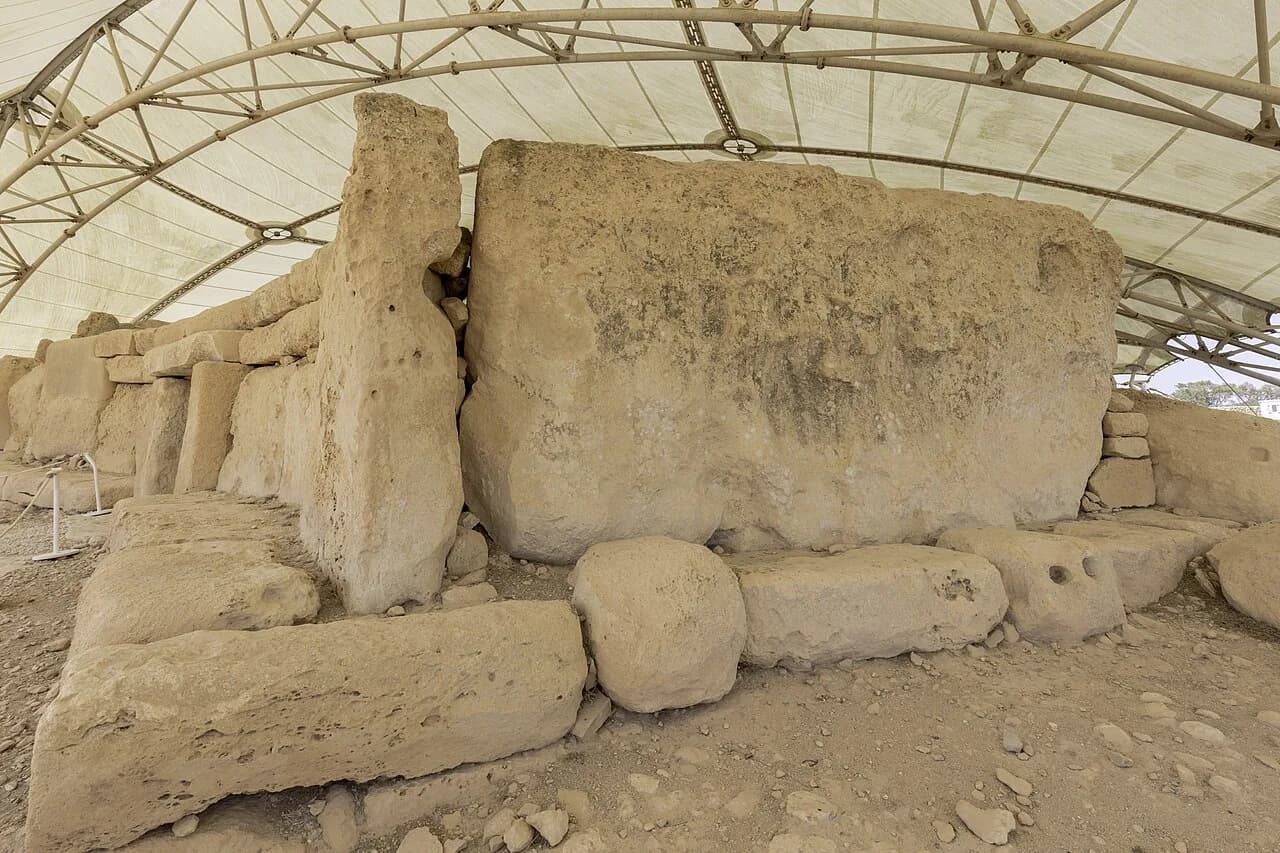
Ħaġar Qim stands on the crest of a ridge at the top of a promontory, with a fertile plain to the east and garrigue sloping down to the sea to the west. The main building is unusual among the Maltese temples because its features and doorways run along the external wall rather than sitting hidden inside a single façade. The site forms an archaeological park with Mnajdra, which is a contemporary construction probably used by the same community given its proximity.
Ħaġar Qim is one of the world's oldest free-standing stone structures, built over 5,500 years ago and predating Stonehenge by nearly a millennium. What matters for planning is simpler: this is a prehistoric temple site on exposed ground with a visitor centre, a marked path to Mnajdra and a car park. If you are working through the island's prehistoric sites in sequence, it helps to see where Ħaġar Qim fits among the megalithic temples of Malta before you book tickets.
The ridge position shapes the visit as much as the stones do. Views open west over the sea, with the small islet of Filfla offshore, while the eastern side looks over the edge of a large plain. Because the ground falls away towards Mnajdra, the return leg from the lower temple is uphill; budget your energy for it rather than treating the 500 metres as flat.
What you actually see at Ħaġar Qim
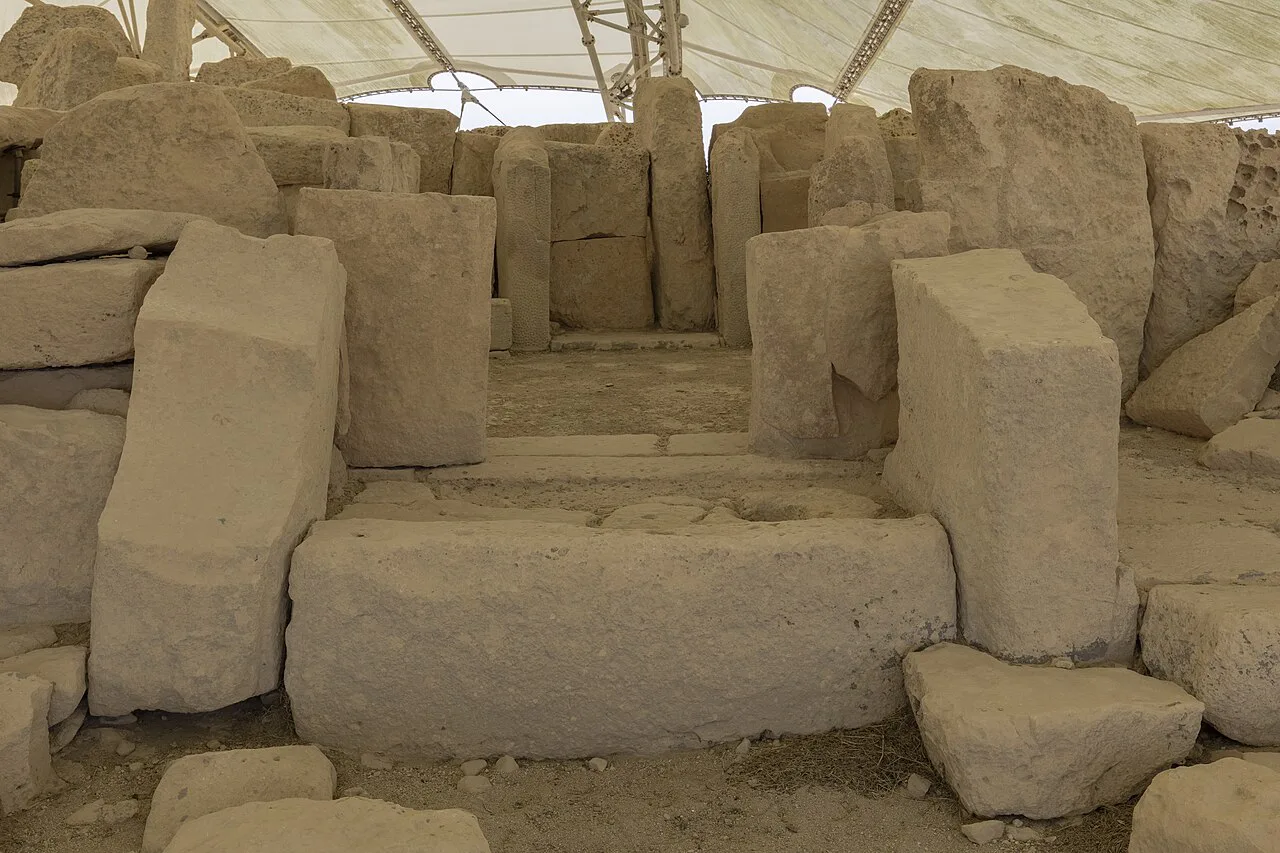
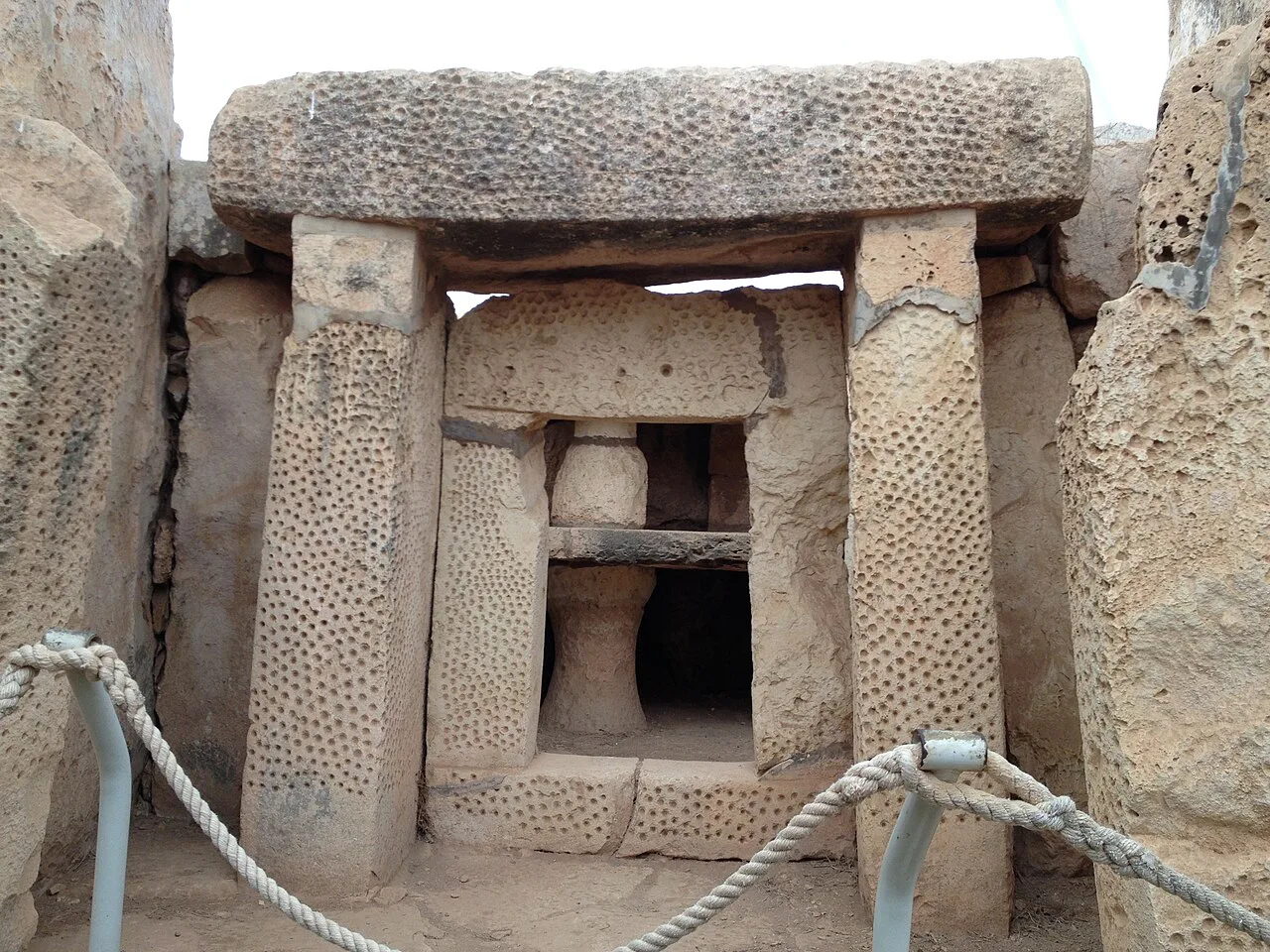
Inside the main building, a central passage paved with stone slabs leads to chambers on either side, and those side chamber floors are beaten earth rather than stone. Doorways come in two forms: trilithon entrances built from two upright blocks with a lintel and threshold, and porthole openings cut through a single megalith. Parts of the buildings were originally covered by a corbelled roof made of successive courses of megaliths, each smaller than the one below.
Look for the carved decoration rather than walking straight past the walls. The original low-relief carvings are displayed at the National Museum of Archaeology in Valletta, and copies now stand in the building on site, so what you see at Ħaġar Qim is a reproduction of work held in the city. Plan the museum as a separate Valletta stop if the carvings are the reason you came.
The stones themselves give the scale: a tour operator's description notes blocks weighing up to 20 tons, and the alignment of the structures with the sun and celestial bodies suggests religious or astronomical use. Read the on-site panels for the interpretation rather than expecting a single agreed explanation of what the temples were for.
Mnajdra, 500 metres downhill
Mnajdra consists of three buildings constructed in both globigerina and coralline limestone, and the sequence of construction is visible in how they sit together. The small three-apsed structure came first, the South building with its concave façade was completed next, and the Central building was then built on an artificial platform between the two earlier structures. Tiny chambers are also built into the thickness of the walls, which rewards a slow circuit rather than a quick photograph.
The South building's doorway aligns with sunrise at the spring and autumn equinoxes. At the winter and summer solstices, beams of the rising sun pass along the sides of the main doorway and strike two decorated slabs inside the first chamber. You will not see that effect on an ordinary midday visit, so treat the alignment as something to understand from the interpretation rather than a spectacle to catch.
The shelters over both temples
Both Ħaġar Qim and Mnajdra are protected from the elements by shelters erected in 2008, intended to slow deterioration until alternative preservation methods are tested and implemented. The decision followed visible decay at sites excavated less than two centuries ago, and it means you view both temples under a modern canopy rather than open sky.
For a photographer, the shelters change the light: the temples sit in filtered rather than direct sun, which flattens contrast on the limestone but also removes harsh midday shadow. They give brief cover if a shower passes, but the walk between the two sites is open, so they are not a substitute for a waterproof layer. Expect the canopy to appear in wide shots and frame closer on the stonework if you want the temples without it.
Tickets, prices and what the pass covers
The Ħaġar Qim ticket includes both Ħaġar Qim and Mnajdra, so there is no second entrance fee at the lower temple. A recent visitor account lists adults at €10, seniors aged 60 and over, students and youths aged 12 to 17 at €7.50, children aged 6 to 11 at €5.50, and infants aged 1 to 5 free. A separate operator guide gives a slightly different child structure, with under-12s free, so confirm the category that applies to you when you buy.
If you plan to visit several prehistoric sites, a Heritage Malta multi-site pass priced at €25 in one guide covers five major archaeological sites, including the Tarxien temples but excluding the Hypogeum. Run the arithmetic against your own list before buying: the pass only pays off if you genuinely intend to use it at multiple sites. Tickets can be bought at the visitor centre or booked online in advance to avoid queues in peak season.
Opening hours by season
Hours shift with the season. A tour-operator guide gives summer hours of 9am to 6pm from April to October with last admission at 5.30pm, and winter hours of 9am to 5pm from November to March with last admission at 4.30pm. A visitor account from January 2025 records a 9am to 5pm day, consistent with the winter pattern.
Last admission matters more here than at a city museum, because both temples and the connecting path take time. Arriving inside the final hour leaves you choosing between Ħaġar Qim and Mnajdra rather than seeing both. Check the Heritage Malta site for the day you plan to travel before setting out, since seasonal hours are set by the operator.
Getting there by bus
Bus 74 leaves Valletta's main bus station, takes about 45 minutes and drops you opposite the approach road to the site. Watch for the large white tent that marks the entrance, and look for the stop named 'Hagar' on the screen. Bus 201, which runs between Rabat and the airport, also passes the same stop, so Rabat is a workable starting point if you are staying in the centre of the island.
From the stop it is roughly a 500-metre walk to the entrance, which is worth factoring in with bags or in heat. A hop-on hop-off bus also stops at the major megalithic temple sites including this park, useful if you want the sites linked without planning routes yourself. Timetables change, so confirm departure times with Malta Public Transport on the day.
Getting there by car
By car from Valletta, head towards Żurrieq and follow signs for Ħaġar Qim along Triq Ħaġar Qim; the drive takes about 20 minutes without traffic. From the airport, a tour-operator guide estimates 15 minutes via Triq l-Avjazzjoni. Both figures assume clear roads, which is optimistic in Malta at busy times, so add slack if you are catching a flight or a ferry.
Parking at the visitor centre is free, with space for roughly 50 cars. In summer, tour buses fill the area by mid-morning, so arriving before 10am secures a space and puts you at the temples ahead of the coach groups. The visitor centre also provides mobility aids on request and has accessible toilets near the entrance, though the ancient stone surfaces are uneven.
How long to allow
Three hours is a sensible minimum for both temples, allowing time in the visitor centre, the walk down to Mnajdra and the uphill return. The 500 metres between the sites is part of the visit rather than dead time, with coastal views opening up as you descend. If your schedule is tighter, see Ħaġar Qim properly and treat Mnajdra as the optional half.
Add time if you are combining the park with another site on the same day. A half-day trip from Valletta is realistic with a car; by bus, the 45-minute ride each way eats into the window. Grouping the park with a southern stop such as the Blue Grotto near Qrendi makes more sense than doubling back to the capital.
What to bring and where the heat bites
Malta's southern coast provides little natural shade, so bring sun protection year-round, not just in July. Comfortable shoes with grip matter because the limestone surfaces become slippery when wet, and the shelters do not cover the paths between sites. Water is essential in summer, when temperatures regularly exceed 30°C.
Midday is the least comfortable slot: the coast is exposed, the shelters trap warmth, and the uphill walk back from Mnajdra comes when the sun is highest. Early morning solves both the heat and the parking, and gives softer light under the canopies. In winter, the same exposure works against you when the wind is up, so a layer that blocks wind is worth carrying.
Nearby sites worth adding
The Blue Grotto near Qrendi, a group of sea caves reached by boat, sits in the same southern corner and pairs naturally with a morning at the temples. The Ħal Saflieni Hypogeum in Paola is the other obvious add-on for anyone following Malta's prehistory, but its timed entry is the one booking that catches people out.
Treat the Hypogeum as a separate booking made well ahead rather than something to slot in after the temples; the underground chambers at the Ħal Saflieni Hypogeum take visitors in limited numbers and timed slots, and turning up without one wastes a trip. If your interests run to later prehistory, the Tarxien temples in Paola sit on the same ticket-pass network and are easier to reach from Valletta.
Anyone building a longer prehistoric itinerary can extend to Gozo for the Ġgantija Temples in Xagħra, Gozo, or stay on the main island with the Skorba temples and Ta' Ħaġrat near Mġarr. Each has its own access arrangements, so treat them as separate outings rather than one loop.
Is the trip to Qrendi worth it?
Yes, if you give it a morning. The ticket covers two distinct temples, the walk between them is short but real, and the ridge setting above the sea does much of the work. Go early in summer, carry water, wear shoes with grip, and book the Hypogeum separately if you want both in one trip.
Explore more Malta guides
Frequently Asked Questions
How many megalithic temples are there in Malta?
Malta's megalithic temples are spread across several locations on the main islands, and a Heritage Malta multi-site pass covers five major archaeological sites including the Tarxien temples. The pass does not include the Hypogeum, which needs its own timed booking.
Can I see Ħaġar Qim and the Hypogeum on the same day?
It is possible but tight. Ħaġar Qim and Mnajdra together need about three hours, and the Ħal Saflieni Hypogeum at Paola takes visitors in limited numbers on timed slots, so book the Hypogeum separately and well ahead and build your day around that slot.
Sources
Notes for your Malta trip
Optional updates when we add or correct a Malta or Gozo guide.
You might also like
Continue reading
More guides you'll find useful