Ħal Saflieni Hypogeum: Visiting Malta's Underground Site
The Ħal Saflieni Hypogeum in Paola is a three-level underground burial complex seen only on timed guided tours. Here is how to reach it and book ahead.
On this page
The Ħal Saflieni Hypogeum is an underground complex carved into limestone beneath Paola, on Malta's south-eastern edge, and you can only see it on a timed guided tour in a group of no more than ten people. Tickets go on sale well ahead and the daily allocation is small, so this is a site to book before you arrange anything else. This guide covers what lies on each of the three levels, how the visit runs, how to reach Paola by bus, and how to fit the Hypogeum and the Tarxien temples into one half-day out of Valletta.
What the Ħal Saflieni Hypogeum actually is
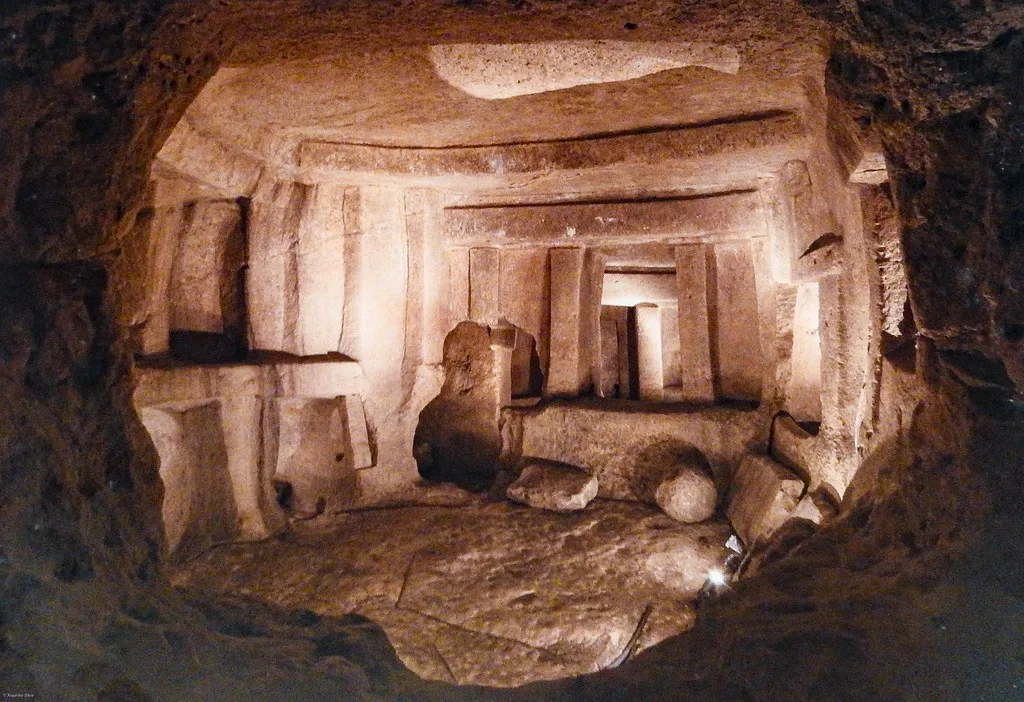
The Hypogeum is a burial complex cut into the bedrock in three levels, covering roughly 500 square metres with 32 chambers and halls. The upper level sits closest to the surface and dates to around 3600–3300 BC, while the lowest level reaches about ten metres down and dates to roughly 3150–2500 BC. It was found by accident in 1902, when construction workers broke through the roof while cutting cisterns for housing in Paola, and full excavation followed in the years after; the site joined the UNESCO World Heritage List in 1982.
The chambers held the remains of an estimated 7,000 people, alongside pottery, beads, amulets and carved animal figures. One room is known as the Oracle Room, named for the way a voice carries and resonates inside it, which is why the site is usually described as a cemetery that may also have served as a place of worship. Red ochre spirals cover parts of the ceilings and walls, most strikingly in that same chamber.
Where it sits in Paola
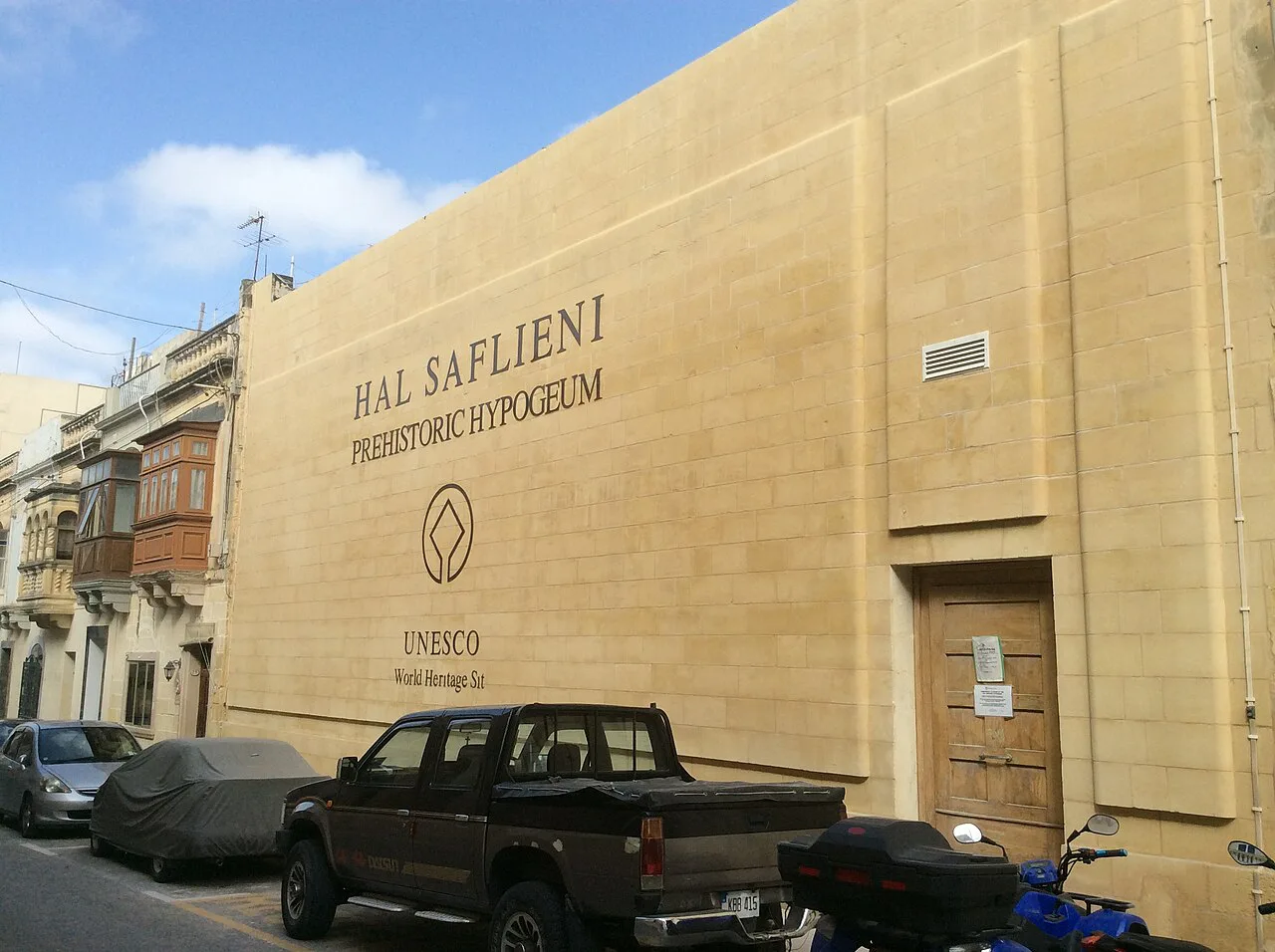
The Hypogeum is in Paola, called Raħal Ġdid in Maltese, a grid-planned town founded in 1626 and named after Grand Master Antoine de Paule. It lies within a short walk of Paola's main bus stop and a few blocks from the Tarxien temples, so one bus ride covers both prehistoric sites. Paola's own centre has a revived main square with shops and cafés if you need to fill time before or after your slot.
How the visit works
You enter through a visitor centre and go round with a guide; groups are capped at ten people to protect the site, and the time underground runs to about 50 minutes to an hour. The route is dim, quiet and enclosed, with narrow passages and low sections, and the air is cooler and more humid than outside. Check the current visitor rules with Heritage Malta before you go, as photography and access conditions can change.
Booking ahead, and the next-day fallback
Only 80 visitors are admitted each day, in groups of ten, and the Hypogeum has been open daily from 10:00 to 18:00. Tickets are sold through the Heritage Malta booking system, and demand is such that you should buy several months ahead for a specific date and time.
If your dates are gone, a small allocation of about 20 tickets is released for the following day, sold from noon and 4pm at the Fort Elmo ticket office in Valletta; the office opens at 9am, so arriving early gives you the best chance. Tickets occasionally turn up over the counter in Paola at short notice, though they may cost more. Treat any such arrangement as something to confirm on the day rather than a guarantee.
If the Hypogeum is sold out for your whole stay, the Tarxien temples a few blocks away are the obvious substitute, and the wider set of megalithic temples Malta protects gives you several more options across the islands; see our guide to the Megalithic Temples of Malta.
Getting to Paola from Valletta and the Three Cities
From Valletta the bus takes roughly 20 minutes on routes 1, 2, 3, 91, 92 or 93. From Senglea in the Three Cities it is about 8 minutes on routes 1 or 213. Get off at Paola's Boni West Side stop, then follow the Hypogeum signs on foot for 5 to 10 minutes.
Driving is straightforward but parking around Paola's grid streets is tight on weekday mornings, so the bus is the simpler choice if you are based in Valletta or the harbour towns. Whichever way you arrive, build in a buffer: the walk from the stop is short but allow extra time, and late arrivals may not be admitted to a timed slot.
What you actually see underground
On the upper level you pass the original burial pits, cut as shafts with an oval chamber at the bottom where bodies were placed in a crouched position with decorated pots and personal belongings. The middle level echoes the layout of Malta's above-ground temple sites, and the lowest level, about 10.6 metres below the surface, has four side niches. The red ochre spirals are the detail most people remember, painted with a hematite-based pigment on ceilings, walls and the Oracle Chamber.
The acoustics of the Oracle Room are the other highlight: measurements taken in the chamber put a male voice at around 114Hz, a resonance that would have amplified chanting during rituals. Your guide will explain what is understood about the room and what remains uncertain, which is a fair amount.
The Sleeping Lady, and where to see her
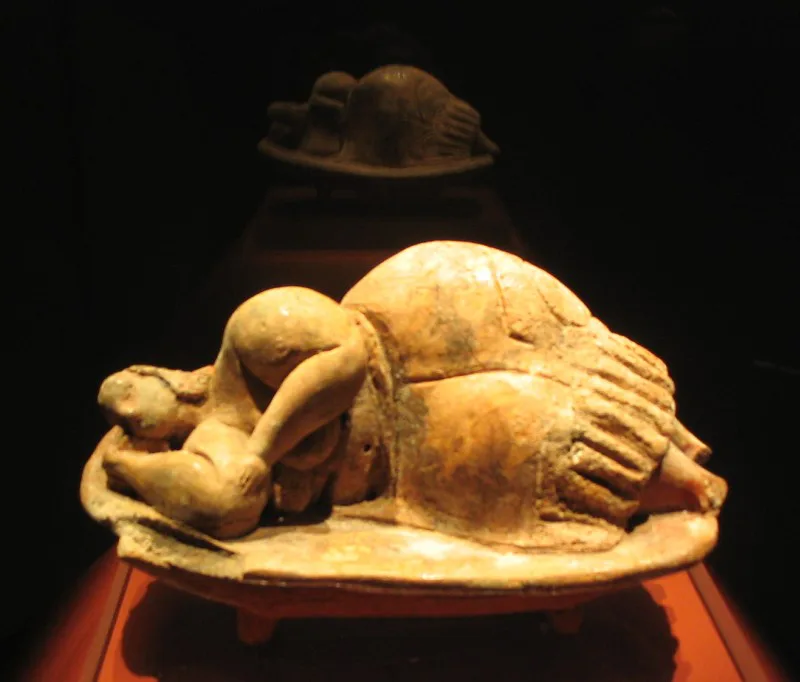
The figurine known as the Sleeping Lady came from the Hypogeum: a small clay figure of a woman lying on her side on a bench, about 12 centimetres long. She is not on show underground. She is held at the National Museum of Archaeology in Valletta, so plan a separate stop there if the figurine is the reason for your interest.
Pairing it with Tarxien and the rest of a Paola half-day
The Tarxien temples sit a few blocks from the Hypogeum and have also been open from 10:00 to 18:00, which makes a natural two-site morning or afternoon. Book the Hypogeum slot first and fit Tarxien around it, rather than the other way round.
If you are building a longer prehistoric itinerary, the Ġgantija Temples in Xagħra on Gozo and the Ħaġar Qim and Mnajdra complex on Malta's south coast are the other headline sites, and each needs its own half-day. Paola's Christ the King Parish Church, with its silver domes, and the older Church of Saint Ubaldesca fill an hour if you are early for your slot.
Who should skip it
The Hypogeum is not for everyone. The passages are narrow and the route is enclosed for the better part of an hour, so anyone uneasy underground will not enjoy it, and the site's protection rules mean there is no shortcut out mid-tour. Limited mobility is also a real constraint given the steps and uneven rock floors, so ask Heritage Malta about access before booking if that applies to you.
If your trip is short and centred on Valletta, the Sleeping Lady at the National Museum of Archaeology and the Tarxien temples give you the essence of Malta's prehistory without the booking gamble. Save the Hypogeum for a trip where you can commit to a date months out.
Should you build your day around the Hypogeum?
Yes, if you can commit to a date well ahead and you are comfortable underground for an hour. Book the Heritage Malta slot months out, then build the rest of the day around Paola: Tarxien a few blocks away, the Sleeping Lady in Valletta, and the bus back to the harbour.
If the tickets are gone, do not hang the day on the next-day allocation at Fort St Elmo. Take Tarxien, the National Museum of Archaeology and one more temple site instead, and leave the Hypogeum for a return trip with a fixed date.
Explore more Malta guides
Sources
Notes for your Malta trip
Optional updates when we add or correct a Malta or Gozo guide.
You might also like
Continue reading
More guides you'll find useful