Malta Catacombs: St Paul's and St Agatha's in Rabat
Malta's catacombs lie under Rabat beside Mdina. Here is what is inside St Paul's and St Agatha's, how long each takes and how to pair them with Mdina.
On this page
Malta's catacombs are underground Roman burial chambers cut into the soft limestone beneath Rabat, the town immediately outside Mdina's walls. St Paul's Catacombs is the complex most visitors tour, and it sits roughly 500 metres from Mdina's main gate, which makes it easy to pair with the walled city on foot.
This guide covers what is actually down there, how St Paul's and St Agatha's differ, how long to allow and how to reach Rabat from Valletta. It also flags the one confusion that catches people out: these catacombs are not the Ħal Saflieni Hypogeum.
What Malta's catacombs are
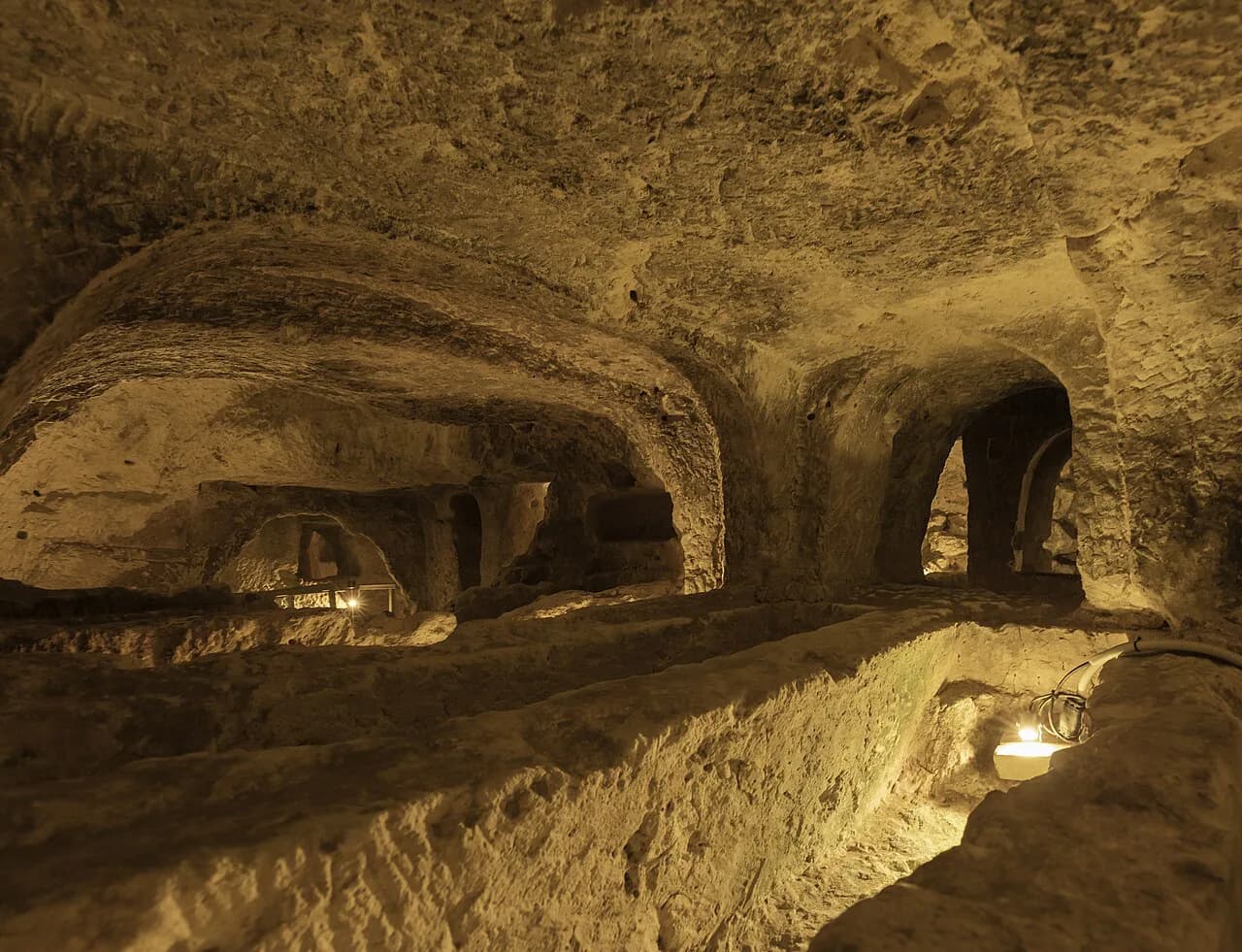
The catacombs are not natural caves. They are systems of passages and tombs carved by hand into the limestone bedrock beneath Rabat, used for burial and commemoration across several centuries. The Rabat complexes were cut and used between the third and eighth centuries CE, and they preserve burial spaces, inscriptions and architectural features that show a community at the maritime crossroads of the central Mediterranean.
Rabat derives its name from the Arabic word for 'suburb' because it grew outside Mdina, the old capital. In Roman times the dead were buried outside the city walls, so the bedrock beyond Mdina became a landscape of underground cemeteries. For the wider story of the island, our Malta History guide sets the Roman and early Christian periods in sequence.
Where the catacombs are in Rabat
The main complexes cluster in the Ħal Bajjada area of Rabat, also known as Tad-Dlam. St Paul's Catacombs is about 500 metres from Mdina's main gate, so you can walk between the two in minutes rather than taking transport.
More than 30 hypogea are scattered across this zone, with the main St Paul's complex sitting within the St Paul cluster. Nearby points of interest include St Paul's Grotto, the Domvs Romana, the Parish Church of St Paul, Casa Bernard and the Wignacourt Museum, so a single morning in Rabat can cover several sites without moving the car.
St Paul's Catacombs: the network
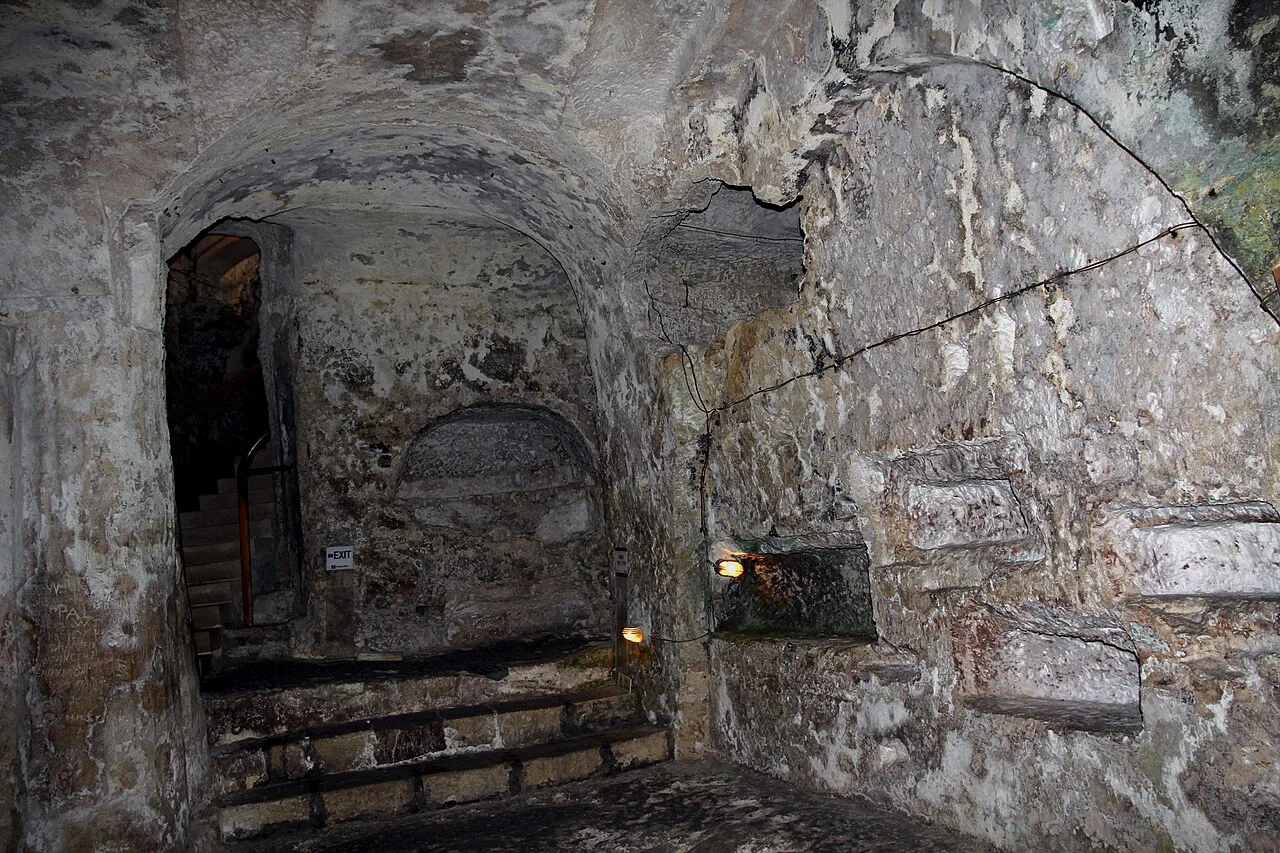
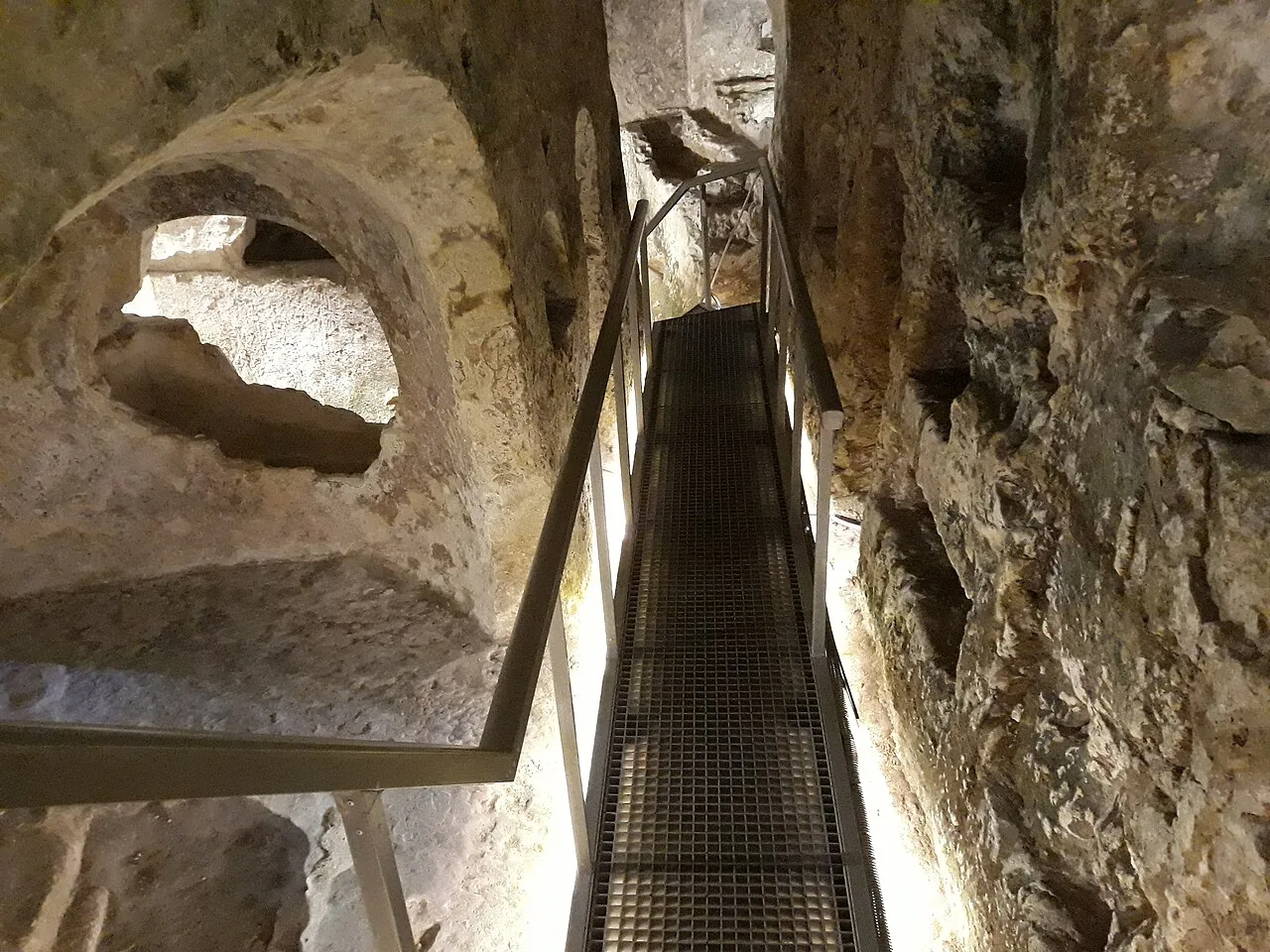
St Paul's Catacombs covers around 2,400 square metres of chambers and passages on two levels, cut from the Globigerina limestone that underlies much of Malta. It is not one open hall: it is a series of family burial complexes, each originally entered from its own surface entrance, which grew together into an interconnected network over the centuries.
Part of the complex, reachable from the parish church dedicated to the same saint, is where tradition holds that St Paul stayed for three months after being shipwrecked on the island. Portions were later reused around the thirteenth century, when open space was re-cut and decorated with murals as a Christian shrine.
Keep the chronology straight. The earliest burials here postdate Paul's shipwreck by around 300 years, so the name reflects later tradition rather than a site he used. The catacombs are part of Malta's early Christian story, one layer in the island's long history.
What you see inside St Paul's
Inside, the vocabulary repays a quick primer. Loculi are simple rectangular niches cut horizontally into the walls and sealed with stone slabs, while arcosolium burials sit under arched recesses and belonged to families of higher status. Window tombs were cut into the floor with a small opening and sealed with carved slabs, and smaller loculi concentrated in particular areas are identified as children's tombs.
A significant portion of the network carries Jewish rather than Christian iconography, including menorahs, shofars and specifically Jewish inscriptions. The presence of both traditions shows a Roman-period population that buried its dead in close proximity while keeping distinct ritual identities.
Decoration is restrained compared with the Roman catacombs: carved geometric patterns and Christian symbols such as the Chi-Rho and the fish, with fragments of coloured plaster lingering on some arches. Tombs line the walls in loculi and arcosolia, and some chambers hold circular tables cut from the rock.
The agape tables
The agape tables are the feature that makes St Paul's memorable. These are circular or semi-circular raised platforms cut from the living rock in the larger chambers, ringed by benches also cut from stone. The early Christian community gathered at them above the family tombs for ritual meals commemorating the dead, combining Roman funerary custom with Christian meaning.
Walking around a table-and-bench arrangement makes the site legible as a social space: living people sat and ate beside their family graves. Similar rock-cut tables appear in other chambers and are often called triclinia, though their precise function is debated.
The Domvs Romana next door
At surface level beside the catacomb entrance, the Domvs Romana museum preserves the remains of a substantial Roman townhouse from around the first century BCE. It was uncovered in 1881, and the highlight is a set of polychrome floor mosaics in coloured tessera.
The Domvs Romana can be visited in its own right, and its adult entry costs six euros; St Paul's Catacombs and the Domvs Romana together are covered by a combined ticket, which is the sensible way to see both. Check Heritage Malta, which runs the site, for the current St Paul's Catacombs ticket price before you go.
St Agatha's Catacombs: the second Rabat complex
St Agatha's Catacombs is the other main underground complex in Rabat, and it belongs to the same early Christian landscape rather than being a duplicate of St Paul's. If you have time for one, take St Paul's for the scale and the agape tables; take St Agatha's if you want a second, quieter look at the same tradition.
Visiting arrangements, opening hours and admission for St Agatha's are listed on the VisitMalta page for the site, so check there before you build a day around it.
How long you need
Allow 45 to 60 minutes for the St Paul's catacombs alone, and around 1.5 hours if you add the Domvs Romana. The underground passages are narrow in places and the floors uneven, so the time reflects a slow, careful walk rather than a quick pass-through.
You can visit without a guide: the St Paul's site is well interpreted, and the panels explain the tomb types and the agape tables as you go. A guided tour helps if you want the chronology and the Jewish-Christian overlap explained in sequence.
Getting to Rabat from Valletta
Buses 51, 52 and 53 run from Valletta to Rabat and take roughly 35 to 40 minutes. From the stop, the catacombs and Mdina's gate are both on foot, so you do not need a car for this trip.
Aim to arrive in the morning. Mdina fills up through the early afternoon, and doing the underground chambers first leaves the walled city for the busier part of the day.
Pairing the catacombs with Mdina
The catacombs and Mdina make a natural half-day because the two sit on the same ridge. Walk up from Ħal Bajjada into Mdina through the main gate, and the change from burial chambers to a fortified grid of streets takes minutes.
If you are following Malta's later history, the Knights Hospitaller rebuilt and refortified much of what you see above ground, and their story is covered in our guide to the Knights Hospitaller.
Who should skip it
The catacombs are tight, low and enclosed, and visitors who dislike confined spaces should think carefully before going down. The passages are narrow and the lighting is deliberately subdued, so the atmosphere is part of the experience rather than an accident.
Anyone expecting the scale of Rome's catacombs will find these smaller, and the decoration is sparser. Go for the agape tables and the intimate family chambers, not for vast painted galleries.
Mistakes to avoid
St Paul's Catacombs is not the Ħal Saflieni Hypogeum. They are separate underground sites with separate tickets, and the Hypogeum is the one that sells out weeks ahead, so do not turn up in Rabat expecting to see it.
Nor are these Pauline sites in any literal sense. The burials here are later than the shipwreck narrative, and the connection is one of tradition and naming rather than of Paul's own use of the chambers.
Is St Paul's Catacombs worth the detour?
Yes, if you are already heading to Mdina. The catacombs add an underground layer that the walled city cannot show you, and the agape tables are the detail most visitors remember. Budget 45 to 60 minutes, or 1.5 hours with the Domvs Romana, and go in the morning.
Skip it if confined spaces trouble you, or if you want the scale of Rome. If you plan to go down, confirm the current St Paul's ticket and opening hours with Heritage Malta first, and check the VisitMalta page for St Agatha's arrangements.
Explore more Malta guides
Frequently Asked Questions
Are there any catacombs in Malta?
Yes. The main complexes are in Rabat, just outside Mdina: St Paul's Catacombs and St Agatha's Catacombs, both cut into the limestone beneath the town. St Paul's catacombs form a network in the Ħal Bajjada area, and the St Paul's complex is the one most visitors tour.
Is St Paul's Catacombs worth it?
For most visitors heading to Mdina, yes. The agape tables, the family burial chambers and the Jewish section give you something the walled city cannot, and the site sits about 500 metres from Mdina's main gate. Allow 45 to 60 minutes, or 1.5 hours if you add the Domvs Romana.
Can you visit the catacombs without a guide?
Yes. St Paul's is well interpreted, with panels explaining the tomb types and the agape tables, so a self-guided walk works. A guided tour helps if you want the chronology and the overlap between the Christian and Jewish burials explained in sequence.
Sources
Notes for your Malta trip
Optional updates when we add or correct a Malta or Gozo guide.
You might also like
Continue reading
More guides you'll find useful